
Most people assume settling a car accident claim means waiting for a check to arrive. The reality is that the car accident settlement process explained properly looks nothing like that. It involves medical documentation, insurance investigations, demand letters, counteroffers, release forms, and sometimes months of back-and-forth before any money changes hands. This guide walks you through every stage of the car accident claims process so you know what to expect, what to avoid, and how to protect the full value of your claim from day one.
Table of Contents
- Key takeaways
- The car accident settlement process explained from the start
- How insurers investigate your claim
- Timing your settlement: MMI and demand letters
- Negotiations, release forms, and receiving your payment
- Factors that affect settlement amounts and when to hire an attorney
- My take on the settlement process after seeing it up close
- How Accidentsurvivalguide can help you right now
- FAQ
Key takeaways
| Point | Details |
|---|---|
| Don't settle before MMI | Settling before maximum medical improvement risks leaving future medical costs permanently uncovered. |
| Evidence shapes your offer | Photos, police reports, and witness statements directly influence how insurers assess your claim. |
| Release forms are final | Signing a release waives your right to any future compensation, even for injuries you don't know about yet. |
| Attorneys increase outcomes | Claimants with legal representation receive settlements averaging 3.5x higher than those who go it alone. |
| Timelines vary widely | Minor claims can close in weeks; complex injury cases routinely exceed two years. |
The car accident settlement process explained from the start
The foundation of any successful claim is built in the hours and days immediately after the crash. What you do first shapes everything that follows.
Get medical care right away. This is not optional. Even if you feel fine at the scene, injuries like whiplash, soft tissue damage, and concussions often appear days later. A gap between the accident and your first medical visit gives insurers an opening to argue your injuries were not caused by the crash. Document every visit, diagnosis, prescription, and referral from the start.
Collect and preserve evidence at the scene. Your phone is your most powerful tool. Photograph every vehicle, every skid mark, the road layout, traffic signals, and any visible injuries. Get the names and contact information of witnesses before they leave. Obtain the official police report number. These materials feed directly into the liability and damage assessments that insurers use to make settlement offers.
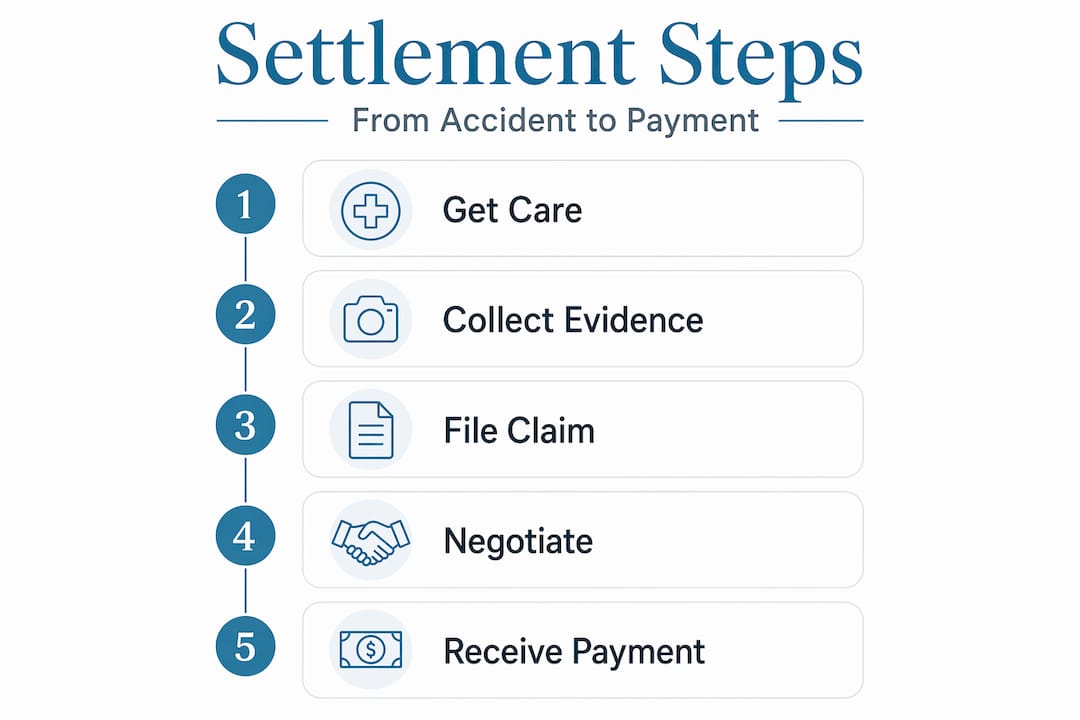
File your insurance claim promptly. Contact your insurer as soon as possible to report the accident. In no-fault states like Florida and New York, your own insurer covers initial medical bills regardless of fault. In at-fault states, the at-fault driver's insurer is primarily responsible. Know which system applies to your state before assuming who pays what.
Pro Tip: When giving a recorded statement to any insurance company, keep every answer factual and brief. Recorded statements can be used to establish liability, and even an offhand guess about speed or road conditions can hurt your case later.
If your injuries are serious, liability is disputed, or the other driver was uninsured, speak with a personal injury attorney before giving any recorded statement at all.
How insurers investigate your claim
Once you file, the insurance company assigns an adjuster whose job is to evaluate the claim from the insurer's financial perspective. Understanding what they do during this phase protects you from being caught off guard.
The adjuster analyzes two things: liability (who was at fault) and damages (what compensation is justified). For liability, they review the police report, photos, witness statements, and sometimes hire accident reconstruction specialists. For damages, they calculate:
- Medical bills already incurred and projected future costs
- Lost wages from missed work
- Property damage to the vehicle
- Non-economic damages like pain, suffering, and emotional distress
Here is where many claimants get surprised. Disputed liability slows everything down. If the insurer argues shared fault, your potential payout drops in proportion to your assigned percentage of blame in most states. Insurance strategies routinely include early low offers and deliberate delays designed to pressure claimants into accepting less than their claim is worth.
Policy limits matter too. If the at-fault driver carries only minimum liability coverage, that cap constrains what you can recover from their insurer regardless of your actual losses. Knowing the applicable policy limits early helps you decide whether to pursue underinsured motorist coverage through your own policy.
The severity of the accident is the single biggest driver of how long this investigation takes. Minor fender-benders can resolve in one to two months. Moderate injury claims typically take six months to a year and a half. Cases involving serious injuries, disputed fault, or multiple parties routinely exceed two years.
Timing your settlement: MMI and demand letters
This is the stage most people mishandle, and the mistakes made here are often permanent.
What is maximum medical improvement? MMI is the point at which your treating physician determines your condition has stabilized and is unlikely to improve significantly with further treatment. It is a medical benchmark, not a legal one. The key rule is simple: settling before MMI nearly always means accepting a number that fails to account for your full medical costs. If you later need surgery, physical therapy, or ongoing pain management, you will pay out of pocket once you have signed a release.
Once you reach MMI, or your attorney determines it is the right time, the process moves to the demand letter. Here is what a well-crafted demand letter includes:
- A clear summary of how the accident occurred and who was at fault
- A complete list of your injuries and medical treatment received
- Documentation of all medical bills, lost wages, and out-of-pocket expenses
- A calculation of non-economic damages like pain and suffering
- A specific dollar amount demanded and a response deadline
After sending the demand, insurers typically respond within 30 to 60 days. Some acknowledge the demand and make a counteroffer. Others request additional documentation. A few ignore the deadline entirely, which is itself useful information about how seriously they are taking your claim.
Pro Tip: Set a firm but reasonable response deadline in your demand letter, usually 30 days. Shorter deadlines can create unnecessary pressure that backfires; longer ones remove urgency. If the insurer misses the deadline, it signals bad faith and strengthens the case for hiring an attorney.
Negotiations, release forms, and receiving your payment
Once the insurer responds to your demand letter, you enter the negotiation phase. This is where most car accident claims settle rather than proceeding to trial. The process typically looks like this:

| Stage | What happens |
|---|---|
| Initial offer | Insurer responds with a figure usually well below your demand |
| Counteroffer | You respond with a revised demand, backed by documentation |
| Back-and-forth | Multiple rounds until both sides reach an agreed number |
| Stalemate | If no agreement is reached, litigation becomes the fallback |
When both sides agree on a number, the insurer sends a release of liability form. Read this document more carefully than anything else in the entire process. Release forms are legally binding and permanently waive your right to pursue additional compensation, even for injuries you were not aware of at the time you signed. Full releases cover every claim related to the incident. Partial releases exist but are far less common.
Risks to watch for include:
- Overly broad release language that extends beyond the accident in question
- Signing before all medical liens are identified and resolved
- Releasing claims against parties who were not part of the negotiation
- Release documents that vary widely in scope and can affect rights you did not intend to waive
After signing the release, payment does not arrive instantly. The settlement agreement and final payment are separate steps. Your attorney (or you, if unrepresented) must resolve any medical liens, health insurance reimbursement claims, and outstanding bills before the net proceeds reach you. This can add two to six weeks after the release is signed.
Pro Tip: Never sign a release without having an attorney or a trusted advisor review the exact language first. Insurance releases can cover far more than the injury you're settling, and that broad language can waive substantial rights you didn't know you had.
Factors that affect settlement amounts and when to hire an attorney
The value of your claim is not random. Specific factors consistently push settlements higher or lower, and understanding them helps you set realistic expectations and recognize when you are being low-balled.
Key factors that influence your final number include:
- Injury severity. Fractures, spinal injuries, and traumatic brain injuries command significantly higher settlements than soft tissue strains.
- Disputed fault. Any shared fault percentage reduces your compensation under comparative negligence rules in most states.
- Policy limits. The at-fault driver's coverage cap sets a ceiling regardless of actual damages.
- Quality of documentation. Gaps in medical records, missing evidence, or inconsistent statements weaken your position at the negotiating table.
- Attorney involvement. Claimants with attorneys receive settlements averaging 3.5 times higher than unrepresented claimants, even after accounting for the typical 33 to 40 percent contingency fee.
You do not need an attorney for a minor fender-bender with no injuries. But if any of these apply to your situation, get legal representation before your next conversation with the insurer:
- You suffered injuries requiring hospitalization or ongoing treatment
- Liability is disputed or you were partially blamed for the crash
- The insurer is delaying, ignoring your calls, or offering far less than your documented losses
- You were involved in a commercial vehicle, rideshare, or multi-vehicle accident
- Delays and information requests have already prompted you to feel overwhelmed by the process
The common fear that hiring an attorney costs money upfront is a misconception. Personal injury attorneys work on contingency, meaning they get paid only when you do. A free consultation costs you nothing and gives you a professional read on your case's actual value. Check out a resource like car accident settlements overview to understand the range of outcomes before you enter any negotiation.
My take on the settlement process after seeing it up close
I have seen people make the same costly mistake over and over. They settle fast because they need the money, because the insurer sounds friendly, or because they just want the whole painful experience behind them. I understand that impulse completely. But rushing this process is one of the few decisions in life you genuinely cannot undo.
What I have learned is that patience is not passive. It is strategic. Every day you wait until your medical picture is clear is a day your attorney can use to build a stronger demand. Every piece of documentation you add is leverage. The insurer knows what your claim is worth. The question is whether you know it too.
I have also seen the difference an experienced attorney makes firsthand. Not every case requires one, but in cases involving real injury, a good attorney does not just negotiate. They change the entire dynamic of the conversation.
My advice: stay informed, keep records of everything, and do not let urgency be a weapon used against you. The car accident compensation steps are manageable once you understand the sequence. You just need to follow them in the right order and at the right pace.
— Scott
How Accidentsurvivalguide can help you right now
After an accident, you are managing pain, paperwork, insurance calls, and uncertainty all at once. Accidentsurvivalguide was built for exactly this moment.
At Accidentsurvivalguide.com, you will find free, plain-language resources covering every stage of the car accident claims process, from what to do in the first 24 hours to understanding settlement negotiations and protecting yourself from low offers. The platform also connects accident victims with experienced legal professionals nationwide at no upfront cost. Whether you are in California, Pennsylvania, or anywhere else in the country, state-specific guidance is available to help you take the right next step with confidence.
FAQ
How long does a car accident settlement take?
Settlement timelines vary from one to two months for minor claims to over two years for complex cases involving serious injuries or disputed fault. The most reliable way to estimate your timeline is to reach MMI and then assess the insurer's responsiveness.
What is maximum medical improvement and why does it matter?
MMI is the point your doctor determines your condition has stabilized. Settling before you reach MMI risks leaving future treatment costs permanently uncovered, since signing a release closes your claim for good.
Can I negotiate with the insurance company on my own?
Yes, but the data is stark. Unrepresented claimants consistently receive lower settlements. For minor accidents without significant injuries, self-representation may be reasonable. For anything more serious, a free attorney consultation is worth doing before you negotiate.
What happens after I sign the settlement release?
Payment does not arrive immediately. After the release is signed, any medical liens and reimbursement claims must be resolved first. Expect the process to take two to six additional weeks before net funds reach you.
What are common mistakes to avoid during the settlement process?
The biggest mistakes include accepting an early offer before reaching MMI, giving a recorded statement without preparation, and signing a release without reviewing the exact language. Each of these can permanently reduce or eliminate compensation you were entitled to receive.
Recommended
- What to Do After a Car Accident in Houston, TX: Step-by-Step Guide | Accident Survival Guide
- What To Do in the First 24 Hours After a Car Accident | Accident Survival Guide
- Understanding Your Rights After an Accident (General Education) | Accident Survival Guide
- 7 Common Mistakes People Make After a Car Crash | Accident Survival Guide