
You were hit. Now you're dealing with medical bills, missed work, and an insurance company that seems in no hurry to make things right. The demand letter is the single most important document you will send during the accident injury claim process, and most people get it wrong. They send it too early, write it too emotionally, or rely on a generic sample demand letter template that signals inexperience the moment an adjuster reads it. This guide walks you through every step: what to include in a demand letter, how to structure it, when to send it, and what to do when the first offer falls short.
Table of Contents
- Key takeaways
- Your demand letter accident injury guide starts here
- What to gather before you write a single word
- How to write a personal injury demand letter, step by step
- Mistakes that cost claimants real money
- What happens after you send it
- My honest take after working with accident victims
- Get the full support you need from Accidentsurvivalguide
- FAQ
Key takeaways
| Point | Details |
|---|---|
| Time your letter carefully | Never send your demand before reaching Maximum Medical Improvement or you risk undervaluing your claim. |
| Evidence drives settlements | Every injury and limitation must link directly to medical records, bills, and documented proof. |
| Structure matters as much as content | Organize your letter into liability, medical chronology, damages, and personal impact for maximum clarity. |
| Certified mail is non-negotiable | Send via USPS Certified Mail with Return Receipt Requested to create legal proof of delivery. |
| Know what follows your letter | Expect a response within 14 to 30 days and prepare a documented counteroffer strategy in advance. |
Your demand letter accident injury guide starts here
A demand letter is a formal written notice sent to the at-fault party's insurance company stating that you hold their insured responsible for your injuries, listing what you lost, and specifying the dollar amount you are willing to accept to resolve the claim. It is not a complaint letter. It is not a vent session. It is a legal document that opens the door to settlement negotiation and, if ignored, can become evidence in a lawsuit.
Most people misunderstand what a demand letter actually does. It does not force the insurer to pay. What it does is establish the parameters of your claim, signal that you are serious and organized, and put the insurance company on the clock. A strong demand letter establishes credibility, frames negotiation parameters, and consolidates your case's key facts and evidence effectively.
There is also a common misconception that sending any letter is better than sending none. A poorly written demand letter can actually hurt your position. Insurers see thousands of claims. They know when someone is winging it. The moment they sense you do not understand the process, they adjust their strategy accordingly.
"A demand letter is not about expressing how much pain you are in. It is about showing the insurer that your documented losses exceed what they want to pay. Make them feel the weight of the evidence."
What to gather before you write a single word
The most common reason demand letters fail is not bad writing. It is bad preparation. Before you draft anything, you need a complete file of supporting documents. Think of your demand letter as a closing argument. Every claim it makes needs a piece of evidence backing it up.
Here is what to compile:
| Document | Why it matters |
|---|---|
| Police or accident report | Establishes the official record of who was at fault |
| All medical records and bills | Documents the nature, severity, and cost of your injuries |
| Lost wage verification | Pay stubs, employer letter, or tax returns showing income loss |
| Photos and video evidence | Visual proof of vehicle damage, injuries, and scene conditions |
| Out-of-pocket expense receipts | Prescriptions, medical equipment, transportation to appointments |
| Medical chronology summary | Timeline linking your injuries to the accident and ongoing limitations |
The medical chronology deserves special attention. This is not just a list of appointments. It is a narrative connecting the accident to your diagnosis, your treatment, and your current physical limitations. Proper injury documentation is what separates a claim that settles well from one that gets lowballed or rejected.
Pro Tip: Create a simple spreadsheet or checklist tracking each document, the date you obtained it, and whether it has been included in your file. Gaps in your documentation become gaps in your settlement.
Liability documentation matters just as much as medical records. Witness statements, traffic camera footage, and expert accident reconstruction reports all strengthen your position. If you were in a no-fault state like New York, there are additional hurdles. You must demonstrate significant limitation of a body function or an injury lasting 90 of 180 days post-accident before you can even claim pain and suffering damages. Know your state's rules before you write.

How to write a personal injury demand letter, step by step
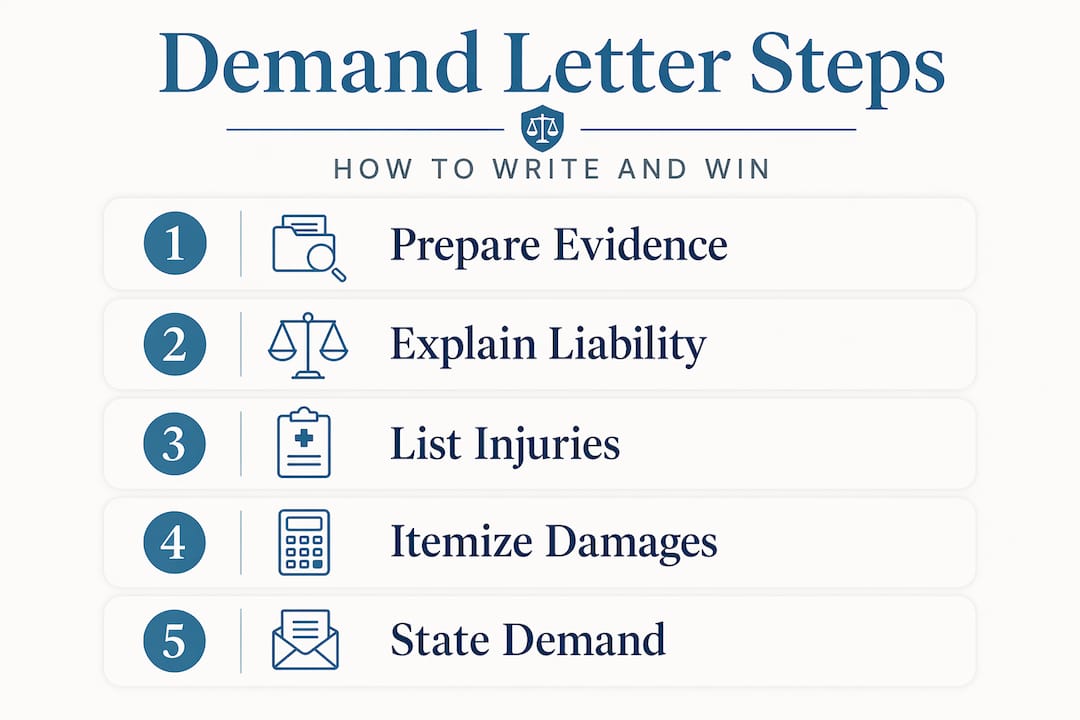
Structure is everything. A well-organized demand letter increases insurer comprehension and settlement likelihood by making your case easy to follow and hard to dispute. Here is how to build it section by section.
-
Opening header and introduction. Start with the date, your name and contact information, the insurer's name and address, and the claim number if you have one. In the first paragraph, state the purpose clearly: you are writing to demand compensation for injuries and losses resulting from the accident on a specific date at a specific location.
-
Liability narrative. Write a concise, factual account of how the accident happened. Stick to facts supported by the police report and evidence. Name the at-fault party. Reference the accident report. Do not editorialize or use emotional language here. Establish negligence with facts, not adjectives.
-
Injury and treatment summary. Describe your injuries, your diagnosis, every treatment you received, and your current status. Use your medical records as the source. Reference specific diagnoses by name. Note if any injuries are permanent or if you face ongoing treatment needs. The goal is to show that your injuries are real, documented, and directly caused by the accident.
-
Damages itemization. Break your damages into two categories. Economic damages include medical bills, lost wages, future medical costs, and out-of-pocket expenses. List each with dollar amounts. Non-economic damages cover pain and suffering, emotional distress, and loss of enjoyment of life. These require more explanation and are often calculated using a multiplier of your economic damages.
-
The monetary demand. State a specific dollar amount. Not a range. Not "somewhere around." A specific number backed by your documentation. According to demand letter requirements, your letter should include a response deadline of 14 to 30 days from the date of receipt.
-
Closing. State that failure to respond may result in legal action. Sign the letter professionally. Attach copies of your key supporting documents.
Pro Tip: Think of your demand letter as a "quantification exercise." Every diagnosis, treatment cost, and physical limitation should link to records that justify your number. The moment you make a claim without documentation, you hand the insurer a reason to reduce the offer.
Mistakes that cost claimants real money
Even a well-intentioned demand letter can backfire. These are the mistakes that show up most often and cost accident victims the most.
-
Sending the letter before Maximum Medical Improvement (MMI). MMI is the point at which your doctor determines your condition has stabilized. Sending demand letters too early allows insurers to argue your injuries are minor and temporary. You also cannot accurately calculate future medical costs if treatment is still ongoing.
-
Using a generic template without customization. Insurers recognize boilerplate language instantly. A copy-paste letter signals that you do not have professional representation and often leads to lower initial settlement offers. Every letter must be specific to your accident, your injuries, and your documented losses.
-
Writing with anger or desperation. An emotional tone undermines your credibility. The adjuster is not going to feel sorry for you. They are going to look for weaknesses. Stay professional, factual, and precise.
-
Failing to send it correctly. Always send via Certified Mail with Return Receipt Requested. Also send a copy by regular first-class mail. If an insurer claims they never received your letter, certified mail creates the paper trail that protects you.
-
Not anticipating insurer defenses. If you know the other driver will claim you were partially at fault, address it in your letter using evidence. If your prior medical history could be used against you, acknowledge it and explain why the accident caused new or worsened injuries.
"Avoid answering detailed insurer questions before consulting with professionals. Early careful communication preserves your claim's integrity and prevents you from accidentally minimizing your own case."
What happens after you send it
Once your letter is delivered, the clock starts. Most insurers will acknowledge receipt within a week or two. Their actual response, which may come in the form of an acceptance, a partial offer, or a denial, typically arrives within the 14 to 30 day window you specified.
Here is what to realistically expect depending on the complexity of your claim:
| Claim type | Expected timeline |
|---|---|
| Minor injuries, clear liability | 2 to 6 months to resolve |
| Moderate to serious injuries | 6 months to 1.5 years |
| Complex or disputed liability | 1 to 2 or more years |
When the first offer comes in, do not panic and do not accept immediately. Initial offers from insurers often test your understanding of the claim process. They are rarely the insurer's best offer. A professional, evidence-based counteroffer that addresses omissions, factual errors, and uses your documentation will significantly improve your position. You can find additional guidance on responding to low offers in a personal injury settlement guide covering key negotiation steps.
If the offer is far too low or the insurer ignores your letter entirely, you have two realistic options. You can escalate through negotiation with the help of an attorney, or you can file a lawsuit. Most cases settle before trial, but the credible threat of litigation is often what moves an insurer off a lowball number.
Pro Tip: Never make your counteroffer verbally. Put everything in writing. Reference specific line items in their response that you dispute, and provide supporting documentation for each point you challenge.
My honest take after working with accident victims
In my experience working with accident victims through Accidentsurvivalguide, the single most damaging mistake I see is treating the demand letter like a personal letter. People want the adjuster to understand how much they have suffered. That impulse is human. It is also strategically wrong.
What I have learned is that adjusters respond to evidence, not emotion. When a demand letter reads like a journal entry instead of a legal document, the insurer gains control of the negotiation. I have seen cases where a victim had a genuinely serious injury but received a fraction of what they deserved because their letter was vague, disorganized, and unsupported by documentation.
The other thing I feel strongly about: patience is a skill in this process. Rushing to send a demand letter before you know the full scope of your injuries will cost you. Taking the time to reach MMI, gather every record, and build a clean documented case is not delay. It is leverage. The insurer is not going anywhere. Make them wait while you build something they cannot easily dismiss.
I also encourage you to take advantage of resources like understanding your rights before you engage with an insurance company at all. Knowing where the traps are changes how you navigate the entire process.
— Scott
Get the full support you need from Accidentsurvivalguide
Accidentsurvivalguide was built by accident survivors who know how overwhelming the claim process feels from the inside. Whether you were in a car, truck, or motorcycle accident, the platform gives you free, practical resources to protect yourself and make informed decisions. From state-specific guidance on California accident claims and New York accident procedures to understanding insurance company tactics and avoiding costly mistakes, Accidentsurvivalguide covers the full picture. Before you send that demand letter, and before you accept any offer, visit Accidentsurvivalguide.com to make sure you have everything you need to protect your claim.
FAQ
What is a demand letter in an accident injury claim?
A demand letter is a formal document sent to the at-fault party's insurer stating your injuries, losses, and the dollar amount you are requesting to settle the claim. It opens the negotiation process and sets the legal tone for your case.
When should you send a demand letter after an accident?
Send your demand letter only after reaching Maximum Medical Improvement so your total damages, including future costs, are fully documented. Sending it too early often results in a lower settlement offer.
What should you include in a demand letter?
Include a factual liability narrative, a complete injury and treatment summary, an itemized list of economic and non-economic damages, and a specific monetary demand with a response deadline of 14 to 30 days.
What if the insurance company ignores your demand letter?
If the insurer does not respond within your stated deadline, you can send a follow-up letter, escalate negotiations with an attorney, or file a lawsuit. Documented delivery via Certified Mail protects your legal standing throughout.
How long does it take to settle after sending a demand letter?
Minor claims often resolve within 2 to 6 months. Moderate to serious injury cases typically take 6 months to 1.5 years. Complex disputes with contested liability can extend well beyond two years.