
The first 24 hours after a car accident determine the outcome of your health recovery, insurance claim, and any legal action you may pursue. What you do in those hours creates the medical record, the evidence trail, and the communication history that insurers and attorneys will scrutinize for months. Adrenaline masks pain, memories fade, and accident scenes change within minutes. This guide covers every critical step, from the moment the crash happens to the end of that first day, so you protect yourself before costly mistakes become permanent.
What to do in the first 24 hours after a car accident
Your first priority is physical safety, not paperwork. Check for injuries to yourself and every other person involved, even if no one is crying out in pain. If vehicles are drivable and the location is dangerous, move them to the shoulder or a nearby parking lot. If moving is not possible, turn on your hazard lights immediately and stay inside until emergency services arrive.
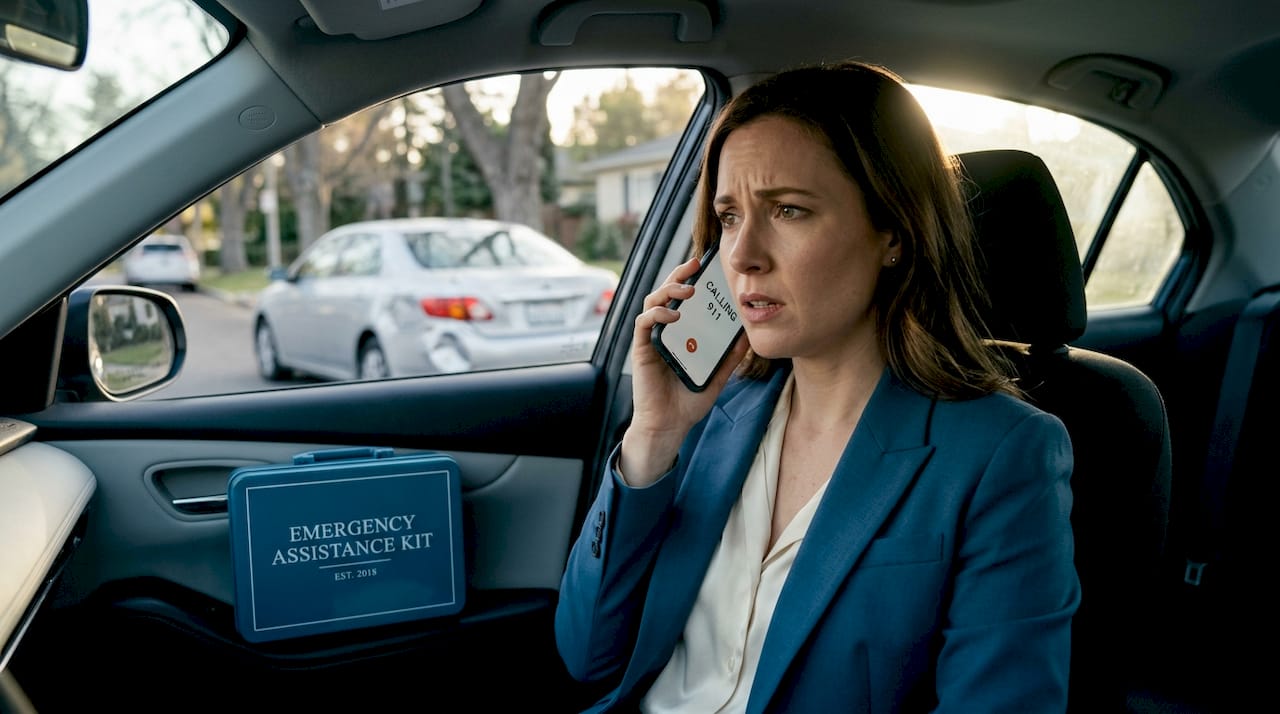
Call 911 any time there is an injury, an unsafe road condition, or a dispute about what happened. Do not assume the other driver will call. Do not assume the accident is too minor to report. Police presence creates an official record that protects you regardless of fault.
Why adrenaline is your biggest enemy right now
Adrenaline masks pain so effectively that people walk away from serious crashes feeling fine, only to wake up the next morning unable to move their neck. Whiplash, soft tissue tears, internal bruising, and even mild traumatic brain injuries routinely show no symptoms for 12 to 48 hours after impact. Feeling okay at the scene is not medical clearance.
Visit an emergency room, urgent care center, or your primary care physician within 24 hours of the crash, even if you feel no pain at all. That visit creates a medical record that links your injuries directly to the accident date. Without it, an insurance adjuster can argue your injuries came from something else entirely, and that argument is very hard to defeat later.
Symptoms that require same-day emergency care include loss of consciousness, confusion, severe headache, blurred vision, numbness in the limbs, abdominal pain, and difficulty breathing. Do not wait to see if these resolve on their own.
Pro Tip: Tell the treating physician exactly how the accident happened and describe every symptom, no matter how minor. "My neck feels a little stiff" belongs in that medical record. Vague or incomplete descriptions give insurers room to minimize your injuries.
How to document the accident scene before it disappears
Scene documentation is time-sensitive in a way that nothing else in this process is. Vehicles get towed, weather changes, skid marks fade, and witnesses leave. Capturing the crash scene before any of that happens is the single most powerful thing you can do for your claim.
Follow this sequence at the scene:
- Photograph all four sides of every vehicle involved, including close-ups of damage and wide shots showing vehicle positions relative to each other and the road.
- Capture license plates, street signs, traffic signals, and any skid marks or debris on the road surface.
- Record a short video walking around the scene to show the full context that still photos miss.
- Note the exact time, date, weather conditions, road surface, and lighting in a voice memo or written note.
- Collect the full name, phone number, and insurance company of every other driver. Get their policy number and driver's license number as well.
- Ask any witnesses for their name and phone number before they leave. A witness who saw the other driver run a red light is worth more than almost any other piece of evidence.
Pro Tip: Your phone's camera automatically embeds a timestamp and GPS coordinates in photo metadata. Do not edit or filter any accident photos. The raw file is evidence.
The table below shows what to collect and why each item matters for your claim.
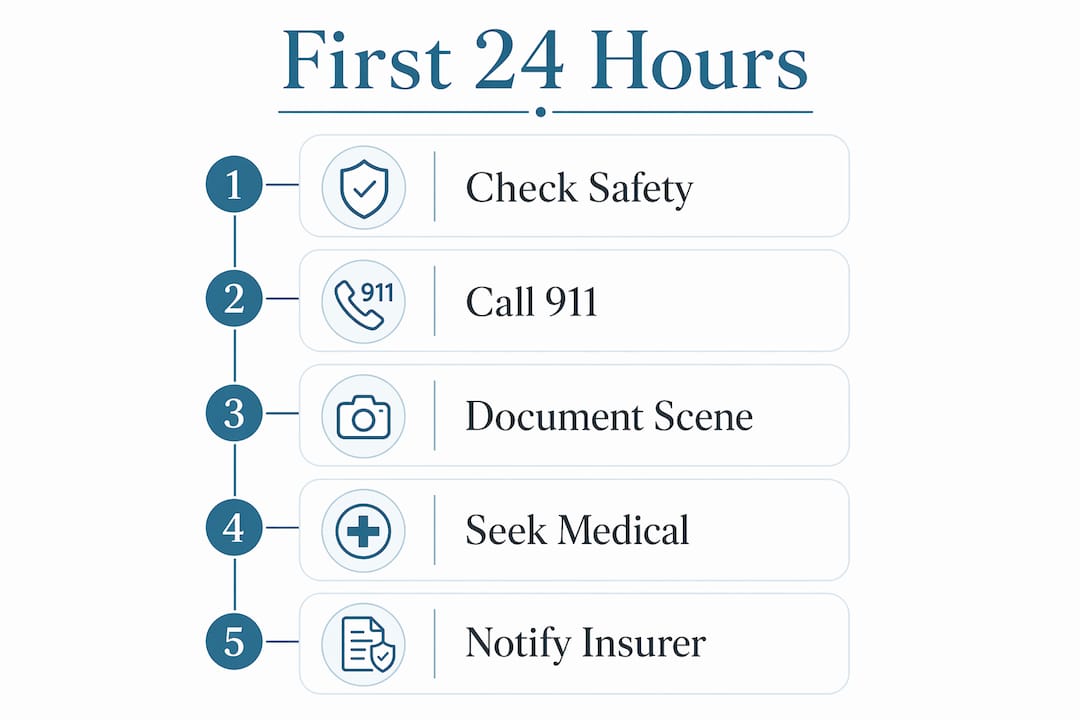
| Document or evidence | Why it matters |
|---|---|
| Time-stamped photos of damage | Proves the extent of damage before vehicles are moved or repaired |
| Other driver's insurance info | Required by your insurer to process a third-party claim |
| Witness contact details | Independent testimony supports your version of events |
| Weather and road conditions | Establishes contributing factors that affect liability |
| Video walkthrough of scene | Captures spatial relationships that still photos cannot convey |
Insurance claims hinge on contemporaneous documentation. Delays in gathering this evidence make proving causation significantly harder, and that difficulty translates directly into lower settlements or denied claims.
When do you need a police report?
A police report is official documentation that an accident occurred, when it occurred, and what the responding officer observed. Many states legally require you to report accidents that result in injury or property damage above a certain dollar threshold. Even where it is not legally required, police reports support insurance claims by providing a neutral third-party account of the scene.
Here is what to do regarding law enforcement at the scene:
- Call 911 and request police if there is any injury, significant vehicle damage, or disagreement about what happened.
- When the officer arrives, give a factual account of what you observed. Do not speculate about fault or apologize.
- Ask the responding officer for the report number before they leave. This number lets you request the full report once it is filed, typically within 3 to 10 days depending on the jurisdiction.
- Keep a copy of the police report in your accident file alongside your photos, medical records, and insurance correspondence.
Not having an official report puts you in a weaker position if the other driver later changes their story. Insurers treat unverified claims with more skepticism, and the absence of a report can delay or reduce your payout.
Navigating insurance calls and what not to say
Report the accident to your own insurance company on the same day it happens. Most major insurers, including those with mobile apps like the GEICO Mobile app, allow you to open a claim digitally within minutes. ERIE Insurance recommends timely insurance notification and cautions against making detailed statements before you have a full picture of your injuries.
When you call your insurer, stick to the basic facts: the date, time, location, and the other driver's information. That is all they need to open a file. What you should not do:
- Do not give a recorded statement to the other driver's insurance company without speaking to an attorney first.
- Do not estimate your injuries or say you are "fine." You do not know that yet.
- Do not speculate about who was at fault, even if you believe the answer is obvious.
- Do not accept a settlement offer within the first 24 hours. You have not yet seen a doctor or received a repair estimate.
"Early recorded statements can be used against you in claims." Overbey, Hawkins, Wright & Vance note that premature recorded statements are one of the most common ways accident victims inadvertently damage their own cases.
The emotional impact after a car accident is real and often underestimated. Shock, anxiety, and the pressure to resolve things quickly can push you into saying more than you should. Slow down. Your insurer needs notification, not a full deposition, on day one.
Common mistakes that hurt your claim in the first day
Most of the damage done to accident claims happens in the first 24 hours, not weeks later in a courtroom. These are the errors that consistently cost people money and credibility.
- Skipping the doctor. Feeling fine is not a reason to avoid medical evaluation. Delayed symptoms are common, and a gap in medical care gives insurers grounds to dispute your injuries.
- Leaving the scene without documenting. Once vehicles are towed and the scene clears, that evidence is gone permanently.
- Admitting fault at the scene. Even a casual "I'm sorry" can be interpreted as an admission of liability. Stick to checking on people and exchanging information.
- Posting on social media. Social media posts about the accident can be introduced as evidence to contradict your injury claims or establish inconsistencies in your account. Stay off all platforms until your case is resolved.
- Ignoring legal guidance. You do not need to hire an attorney on day one, but you should at least understand your rights before speaking with adjusters. A free consultation with a personal injury attorney costs nothing and can prevent expensive mistakes.
The important documents after accident you gather in this window, including the police report, medical records, photos, and insurance correspondence, form the foundation of everything that follows.
Key takeaways
The first 24 hours after a car accident set the foundation for every health, legal, and financial outcome that follows, making immediate medical evaluation and thorough documentation non-negotiable.
| Point | Details |
|---|---|
| Seek medical care within 24 hours | Adrenaline masks injuries; a same-day visit creates the medical record that links injuries to the crash. |
| Document the scene immediately | Time-stamped photos, witness contacts, and a police report number are your strongest evidence. |
| Notify your insurer the same day | Report basic facts only; avoid recorded statements or injury estimates before a medical evaluation. |
| Avoid admitting fault or posting online | Casual statements and social media posts can be used against your claim months later. |
| Get the police report number | Official documentation protects you if the other driver changes their account of events. |
What I've learned from watching people get this wrong
I co-founded Accident Survival Guide with Kathy Carr because we both lived through the confusion and stress of serious accidents without anyone telling us what actually mattered in those first hours. What I have seen since then confirms one thing repeatedly: the people who protect their claims are the ones who treated the first 24 hours like the most important day of the process, because it is.
The most common story I hear goes like this. Someone walks away from a crash feeling shaken but okay. They exchange information, skip the doctor because nothing hurts, and go home. Two days later their back is in agony. They see a doctor, get treatment, and file a claim. The insurer then points to the gap between the accident date and the first medical visit and argues the injury came from something else. That gap, sometimes just 48 hours, costs people thousands of dollars in settlement value.
The emotional impact after a car accident is also something people underestimate. Shock makes you want to minimize what happened and get back to normal as fast as possible. That instinct works against you. The calm, organized person who takes photos, gets a report number, sees a doctor, and says very little to adjusters is the person who recovers fully, financially and physically.
I also want to be direct about social media. I have seen cases where a single Instagram post showing someone at a party three days after a crash was used by an insurer to argue the person was not seriously injured. It does not matter that you were in pain and pushing through. That photo becomes evidence. Stay off all platforms until your case is closed.
— Scott
How Accident Survival Guide helps you take the right next steps
If you are reading this in the hours or days after a crash, Accidentsurvivalguide was built for exactly this moment.
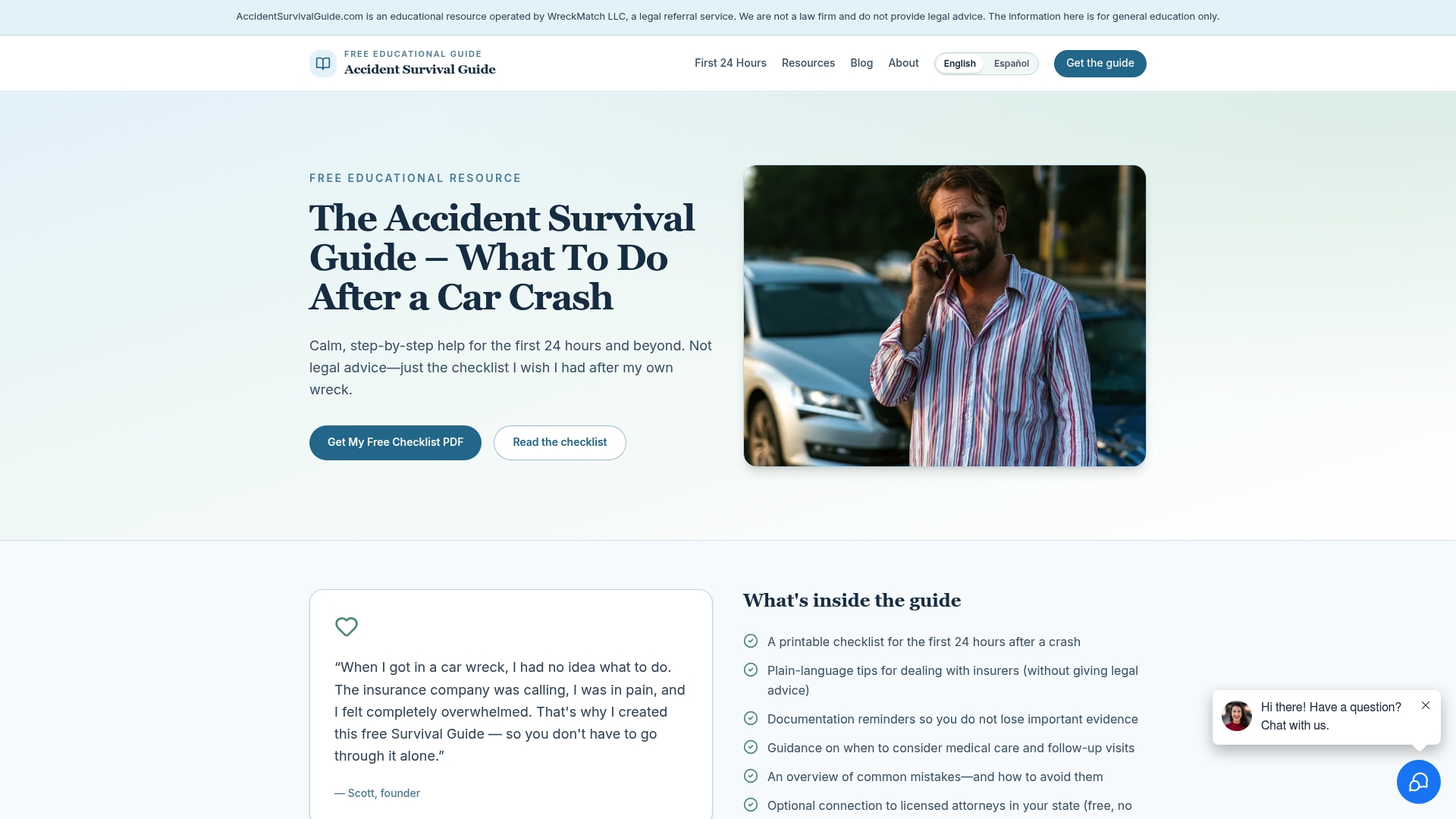
Accidentsurvivalguide provides free, plain-language resources covering every stage of the post-accident process, from the scene to the settlement. The site includes state-specific guides for locations like Oregon, Texas, Arkansas, and New York, so you get guidance that reflects the laws and requirements where your accident actually happened. You will also find checklists, documentation tips, insurance claim guidance, and connections to experienced legal professionals nationwide. Visit Accident Survival Guide to access every resource you need, at no cost, right now.
FAQ
Should I go to the ER if I feel fine after a crash?
Yes. Adrenaline masks injuries like whiplash and soft tissue damage for hours or days after impact. A same-day medical visit creates the record that connects your injuries to the accident date.
What information do I need to exchange at the scene?
Collect the other driver's full name, phone number, driver's license number, license plate, and insurance company name and policy number. Get contact information from any witnesses before they leave.
Can I give a recorded statement to the other driver's insurance company?
You are not required to give a recorded statement to the other driver's insurer, and doing so without legal advice is risky. Premature statements can be used to minimize or deny your claim.
How do I get a copy of the police report?
Ask the responding officer for the report number at the scene. You can then request the full report from the local police department or sheriff's office, typically within 3 to 10 days after the accident.
Is it okay to post about the accident on social media?
No. Social media content can be introduced as evidence to contradict your injury claims or establish inconsistencies in your account. Avoid all posts about the accident until your case is fully resolved.
Recommended
- What To Do in the First 24 Hours After a Car Accident | Accident Survival Guide
- Accident Survival Guide | What To Do After a Car Crash
- What to Do After a Car Accident in Houston, TX: Step-by-Step Guide | Accident Survival Guide
- Immediate Steps to Take After a Car Accident in Denver, Colorado | Accident Survival Guide