
A car accident doesn't just hurt your body. It stops your paycheck. If you've missed work because of your injuries, you have the right to recover that income, but the lost wages car accident claim steps are specific, and insurance companies will reject vague or incomplete submissions without hesitation. This guide walks you through exactly what to document, how to file, what mistakes to avoid, and how state rules affect what you can actually recover. Whether you're an hourly employee, a salaried worker, or self-employed, the process is manageable when you know what's required.
Table of Contents
- Key takeaways
- Lost wages car accident claim steps: the documents you need first
- How to file your claim with the insurance company
- Common mistakes that hurt or kill wage claims
- How state rules and coverage types affect your claim
- My honest take on what actually makes these claims succeed
- How Accidentsurvivalguide can help you right now
- FAQ
Key takeaways
| Point | Details |
|---|---|
| Documentation drives everything | An employer letter, medical work restriction note, and pay stubs form the core of any strong claim. |
| Match restrictions to your job | Your doctor's note must describe limitations that align with your specific job duties, not generic language. |
| Know which insurer to bill first | PIP, at-fault liability, and UM/UIM coverage each apply in different situations and in a specific order. |
| State rules vary significantly | Florida, New York, and Texas each cap and calculate wage benefits differently under their no-fault systems. |
| Organized records speed up payment | A well-documented claim reduces delays, lowball offers, and the risk of outright denial. |
Lost wages car accident claim steps: the documents you need first
Before you file anything, you need to build your evidence package. Insurance adjusters don't take your word for how much work you missed or how much you earn. They require proof, and the bar is higher than most people expect.
The foundation of any car accident wage compensation claim is the employer wage verification letter. This letter must include your job title, hire date, hourly rate or salary, the specific dates you missed work, and the hours lost on each of those dates. A letter that simply says "Jane was out sick" will get rejected. Specificity drives claim acceptance, and a vague employer letter is one of the fastest ways to weaken your case.
Alongside that letter, you need a medical work restriction note from your treating physician. This is not the same as a general diagnosis letter. The note must explicitly state that your injuries prevent you from performing your job duties, list the specific restrictions, and connect those restrictions directly to the accident. Generic notes like "out sick" are routinely rejected by adjusters.
Here's what your full documentation package should include:
- Recent pay stubs (typically the last three to six months)
- Federal tax returns from the prior one to two years
- Employer wage verification letter with specific dates and hours
- Doctor's work restriction note linking injury to missed work
- Documentation of lost overtime, bonuses, commissions, or tips
- Records of PTO you were forced to use due to the injury
- Any benefits you lost, such as employer contributions to health coverage
Lost wages claims should represent your full income picture, not just your base hourly rate. If you regularly worked overtime or earned commissions, those belong in the claim too.
Self-employed workers face a different documentation challenge. Without an employer to write a letter, you need to substitute that proof with business records. Tax filings, bank statements, client contracts, and cancellation emails can collectively establish your baseline earnings and show what work you lost.
Pro Tip: Start a daily journal the day after the accident. Write down your symptoms, what tasks you couldn't do, and any work-related communications you missed. This journal becomes powerful corroborating evidence when an adjuster questions the severity of your injury or the duration of your absence.
How to file your claim with the insurance company
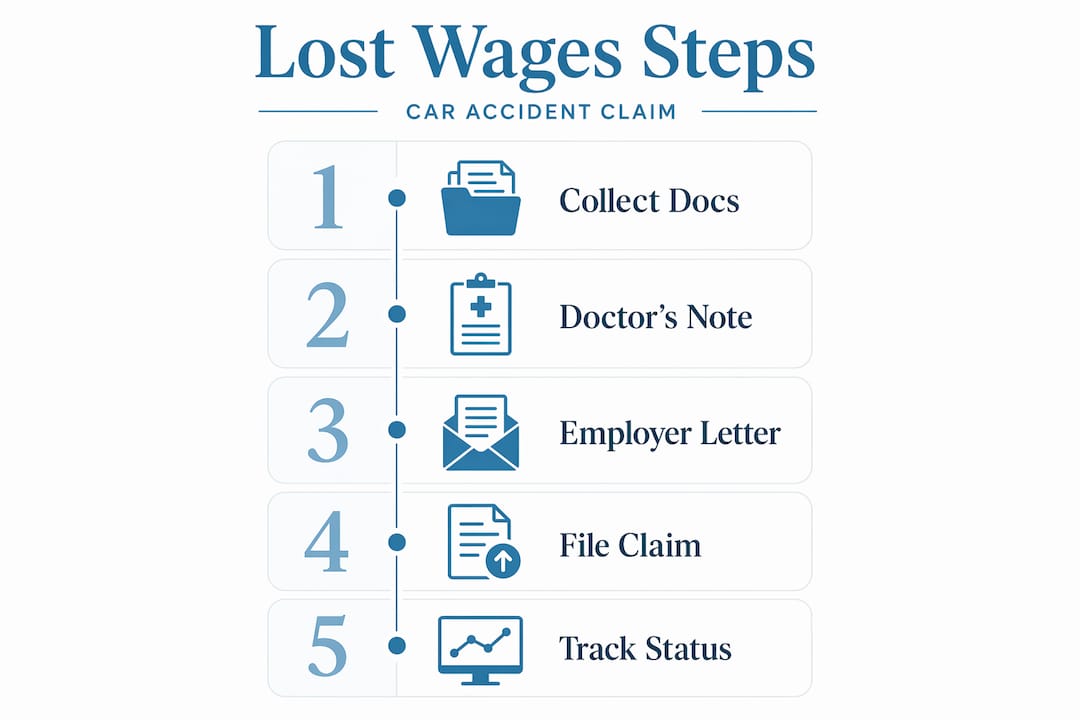
Once your documentation is ready, you follow a specific sequence. Skipping steps or submitting incomplete packages leads to delays, low offers, or denials.
-
Identify the right insurer. In no-fault states, you file with your own Personal Injury Protection (PIP) coverage first, regardless of who caused the accident. In at-fault states, you file against the other driver's liability insurance. If the at-fault driver was uninsured or underinsured, your own Uninsured/Underinsured Motorist (UM/UIM) coverage may apply.
-
Open a claim and get your claim number. Call the insurer, report the accident, and request a claim number immediately. Every document you submit should reference this number.
-
Submit your full documentation package. Send your employer letter, medical restriction note, pay stubs, tax returns, and any supplemental income records together as one organized submission. Sending documents piecemeal creates confusion and delays.
-
Respond promptly to insurer requests. The adjuster may ask for additional records, request an Independent Medical Examination (IME), or ask you to sign medical authorization forms. Respond within their stated deadlines. Missing a deadline can pause or kill your claim.
-
Track every communication. Note the date, time, and name of every person you speak with. Follow up phone calls with a brief written summary sent by email or certified mail.
-
Review any payment offers carefully. If the insurer makes a partial payment, accepting it without written clarification that it is not a full settlement can waive your right to additional recovery.
Pro Tip: Send all major submissions by certified mail and keep digital copies of everything. If a dispute arises later about what you submitted or when, you'll have timestamped proof that protects your claim.
Organizing your records thoroughly from the start reduces delays and the risk of underpayment. Adjusters process dozens of claims at once. A clean, complete file gets resolved faster than a scattered one.

Common mistakes that hurt or kill wage claims
Most car accident income loss claims that fail don't fail because the injury wasn't real. They fail because of documentation gaps that give adjusters a reason to say no.
The single most damaging mistake is a medical note that doesn't match your actual job. Aligning your doctor's restrictions with your specific job duties is often the missing piece that separates approved claims from denied ones. If your doctor writes "avoid heavy lifting" but your job is data entry, an adjuster can argue you could have returned to work. Your doctor needs to know what your job actually requires.
Other common pitfalls include:
- Vague medical notes. "Patient is unable to work" with no specifics gives adjusters room to dispute the timeline and severity.
- Delayed employer cooperation. If your employer is slow to provide a verification letter, don't wait passively. Follow up in writing, and if necessary, request your employment records formally through HR.
- Income discrepancies. If your tax return shows lower income than your pay stubs suggest, adjusters will question which number is accurate. Be ready to explain any differences clearly.
- Talking too freely with adjusters. Don't speculate about your recovery timeline or minimize your symptoms in conversation. Adjusters are trained to use casual statements against you.
"Claims are strongest when documentation creates a coherent timeline: accident date, treatment start, work restrictions start, and exact missed time." Source
If your claim is partially denied, request the denial in writing with a specific reason. That reason tells you exactly what documentation gap to address. You can then resubmit with the missing proof or escalate to an attorney. Reviewing common mistakes after a crash before you file can save you significant time and money.
How state rules and coverage types affect your claim
Where you live has a direct impact on how much you can recover and through which channel. Understanding your state's rules before you file prevents surprises.
| State | Coverage type | Wage benefit | Cap/limit |
|---|---|---|---|
| Texas | PIP (optional) | 80% of lost wages | Up to policy limits |
| New York | No-fault (mandatory) | 80% of gross earnings | $2,000/month, up to 3 years |
| Florida | PIP (mandatory) | 60% of lost wages | Shared $10,000 cap with medical |
Texas makes PIP optional, which means many drivers don't carry it. If you're in Texas without PIP and the other driver is at fault, you claim against their liability insurance directly. If those limits are insufficient, a personal injury lawsuit may be your path to full recovery. You can find state-specific guidance for Texas accident claims at Accidentsurvivalguide.
New York's no-fault system pays 80% of gross lost earnings up to $2,000 per month for up to three years. The benefit is tax-free, and there's a built-in 20% offset designed to approximate your actual after-tax take-home pay. You still need objective medical proof to qualify.
Florida's situation is trickier. The $10,000 PIP cap is shared between medical expenses and wage losses. In serious accidents, medical bills often consume most or all of that cap, leaving little for wage recovery. Florida victims frequently need to pursue the at-fault driver's liability coverage for meaningful wage compensation. Accidentsurvivalguide has a dedicated Florida accident guide that covers this in detail.
For workers who partially return to work, you can still claim the difference between your pre-accident earnings and your reduced current earnings. If your injuries permanently affect your earning capacity, that future income loss is a separate and significant element of a personal injury claim.
My honest take on what actually makes these claims succeed
I've spent years helping accident victims understand why their claims stalled or got denied, and the pattern is almost always the same. The injury was real. The missed work was real. But the paperwork told a different story.
What I've learned is that most wage claims fail without a doctor's note that specifically certifies inability to work. Not a general treatment note. Not a discharge summary. A clear, direct statement from a physician that says: this person cannot perform their job duties because of injuries sustained in this accident. That one document changes everything.
The second thing I've seen people consistently underestimate is the timeline approach. When your documentation tells a clear, connected story from accident date to first medical visit to work restriction to last missed day, adjusters have very little room to dispute it. Gaps in that timeline are where claims fall apart. Adjusters are skeptical of pay stubs alone, and they will probe every gap they find.
My advice: treat your claim like a case file from day one. Every doctor's visit, every email to your employer, every day you couldn't work. Write it down. Date it. Keep it. The people who get paid fairly are almost always the ones who showed up with a complete, organized file and didn't give the adjuster anything to question.
— Scott
How Accidentsurvivalguide can help you right now
If you're dealing with missed paychecks on top of an injury, you don't have to figure this out alone. Accidentsurvivalguide was built specifically for moments like this, by people who've been through serious accidents themselves and know how overwhelming the claims process feels.
At Accidentsurvivalguide.com, you'll find free, plain-language resources covering every stage of accident recovery, from the first 24 hours after a crash to filing insurance claims, understanding your rights, and connecting with experienced legal professionals in your area. The site includes state-specific guides for New York, Texas, Florida, California, Georgia, and more, each tailored to the coverage rules and claim procedures that apply where you live. You've already taken the right step by educating yourself. The next step is making sure you have the right support behind you.
FAQ
What documents do I need to claim lost wages after a car accident?
You need an employer wage verification letter, a doctor's work restriction note linking your injury to missed work, recent pay stubs, and tax returns. Self-employed workers should substitute the employer letter with business records such as tax filings, bank statements, and client contracts.
How long does a lost wages claim take to process?
Processing times vary by insurer and state. In Texas, PIP claims are typically processed within 30 days of a complete submission. Complex claims or those requiring an Independent Medical Examination can take significantly longer.
Can I claim lost wages if I'm self-employed?
Yes. Self-employed workers can claim car accident income loss using tax returns, bank statements, invoices, and client communications that show what work was lost due to the injury.
What happens if my lost wages claim is denied?
Request the denial in writing with the specific reason. Address the documentation gap identified, resubmit with corrected or additional proof, and consider consulting a personal injury attorney if the denial is not resolved.
Does PIP cover all of my lost wages?
No. PIP typically covers a percentage of lost wages up to a policy cap. New York pays 80% up to $2,000 per month, Florida pays 60% within a shared $10,000 cap, and Texas PIP pays 80% up to policy limits. Amounts beyond those caps may require a claim against the at-fault driver's liability insurance.
Recommended
- What To Do in the First 24 Hours After a Car Accident | Accident Survival Guide
- What to do after a car accident in Illinois | Accident Survival Guide
- Car Accident in Miami, FL: Common Insurance Mistakes to Avoid | Accident Survival Guide
- What to do after a car accident in California | Accident Survival Guide