
Handling a personal injury claim without legal representation is one of the most expensive decisions an accident victim can make. The injury claim mistakes without attorney representation that most people commit are not dramatic blunders. They are quiet, cumulative errors that insurance companies count on. Insurers deploy entire teams to minimize payouts targeting unrepresented claimants first, because they know the odds favor them. This guide explains exactly what those mistakes are, why they cost you money, and what you can do about them before it is too late.
What are the most common injury claim mistakes without an attorney?
Self-represented claimants lose ground through predictable, avoidable errors. Knowing them in advance is the only real defense you have.
-
Delaying medical treatment. Seeking care within the first 24 to 72 hours is critical to linking your injury to the accident. Every day you wait gives the insurer grounds to argue your injury came from something else entirely.
-
Talking freely to insurance adjusters. Insurance adjusters are trained to elicit damaging admissions during early recorded statements. A casual remark like "I'm feeling okay" on an initial call can be used months later to reduce your settlement to a fraction of its real value.
-
Accepting the first settlement offer. Quick settlement offers almost always undervalue true damages, especially for serious injuries. First offers never account for future surgeries, ongoing therapy, or lost earning capacity.
-
Posting on social media. Photos of you at a family event, a gym check-in, or even a positive status update can be pulled by defense investigators to contradict your injury claims in court or during negotiations.
-
Failing to preserve evidence. Surveillance footage and physical evidence from accident scenes are often overwritten or lost within 72 hours. If you do not act fast, that evidence is gone permanently.
-
Missing legal deadlines. Critical legal deadlines can permanently bar recovery. Most states allow up to two years to file, but some government claims require action in as little as six months.
-
Underestimating total damages. Most unrepresented individuals underestimate the complexity of calculating non-economic damages like pain and suffering, future medical costs, and diminished quality of life.
Pro Tip: Before you speak with any insurance representative, write down every detail of the accident and your injuries in a private journal. Date every entry. This record becomes your most credible evidence and cannot be taken out of context the way a recorded phone call can.
How do self-represented claims compare in outcomes to attorney-assisted ones?

The outcome gap between represented and unrepresented claimants is not marginal. It is structural, and it shows up in every measurable category.
Unrepresented claimants lack the single most powerful negotiation tool available: the credible threat of litigation. Attorneys use the threat of a lawsuit to push insurers toward maximum settlement figures. Without that leverage, adjusters know you are unlikely to sue, and they price their offers accordingly. The result is a predictable lowball cycle that most unrepresented claimants accept simply because they do not know what a fair number looks like.
Attorneys also negotiate medical liens, often settling liens for 50% or less of the original amount. That reduction directly increases the net money you take home. Self-represented claimants almost never know this negotiation is even possible, let alone how to execute it.
| Factor | With attorney | Without attorney |
|---|---|---|
| Litigation leverage | Strong. Insurer must prepare for trial costs. | Absent. Insurer assumes no lawsuit risk. |
| Lien negotiation | Attorneys routinely cut medical bills by 50% or more. | Claimant pays full lien amount, reducing net recovery. |
| Damage valuation | Includes future costs, pain and suffering, lost capacity. | Typically limited to current medical bills and lost wages. |
| Settlement timing | Attorney controls pace to maximize recovery. | Claimant often pressured into early acceptance. |
"Early consultation with a personal injury attorney improves claim preservation even if you do not retain one immediately." — Charter Chambers
That quote reflects a practical reality. A single consultation, often free, can tell you whether your claim is being undervalued and what evidence you still need to gather. You do not have to hire anyone to benefit from that conversation.
How to avoid injury claim errors when handling your own claim
If you are managing your claim without a lawyer, the following steps represent the difference between a fair recovery and a closed case you regret.
-
Get medical treatment immediately and keep going. Do not skip appointments or stop treatment because you feel better. Gaps in your medical record give insurers the argument that your injuries resolved or were never serious. Your medical documentation is the backbone of your claim.
-
Decline recorded statements politely but firmly. You are not legally required to give a recorded statement to the other driver's insurer. Say you are not prepared to give a statement at this time and that you will follow up in writing. This protects you from off-the-cuff remarks being used against you later.
-
Collect and preserve all evidence within 48 hours. Photograph the scene, your vehicle, your injuries, and any property damage. Request the police report immediately. Contact businesses near the accident location and ask them to preserve any surveillance footage before it is automatically deleted.
-
Stay off social media until your claim is resolved. This is not optional advice. Defense investigators routinely monitor claimant profiles. A single photo or comment can undo months of documented injury treatment.
-
Know your state's statute of limitations. Look up the exact deadline for your state and mark it on your calendar with a 60-day buffer. For government entity claims, the deadline can be as short as six months. Missing it means losing your right to recover anything, regardless of how strong your case is.
-
Do not sign anything without reading it completely. A final release signed prematurely closes your claim permanently, even if you need surgery six months later. Once signed, there is no going back.
-
Use a compensation calculator to benchmark offers. Before you accept or counter any offer, get an independent estimate of what your claim may be worth. Accidentsurvivalguide's free calculator gives you a data-based starting point so you are not negotiating blind.
Pro Tip: Send all communications with the insurance company in writing, even if you spoke by phone first. Follow up every call with an email summarizing what was said. This creates a paper trail that protects you if the adjuster later misrepresents what was agreed.
What legal nuances do self-represented claimants often miss?
The procedural and legal details of personal injury claims are where self-represented claimants lose the most ground. These are not technicalities. They are claim-ending traps.
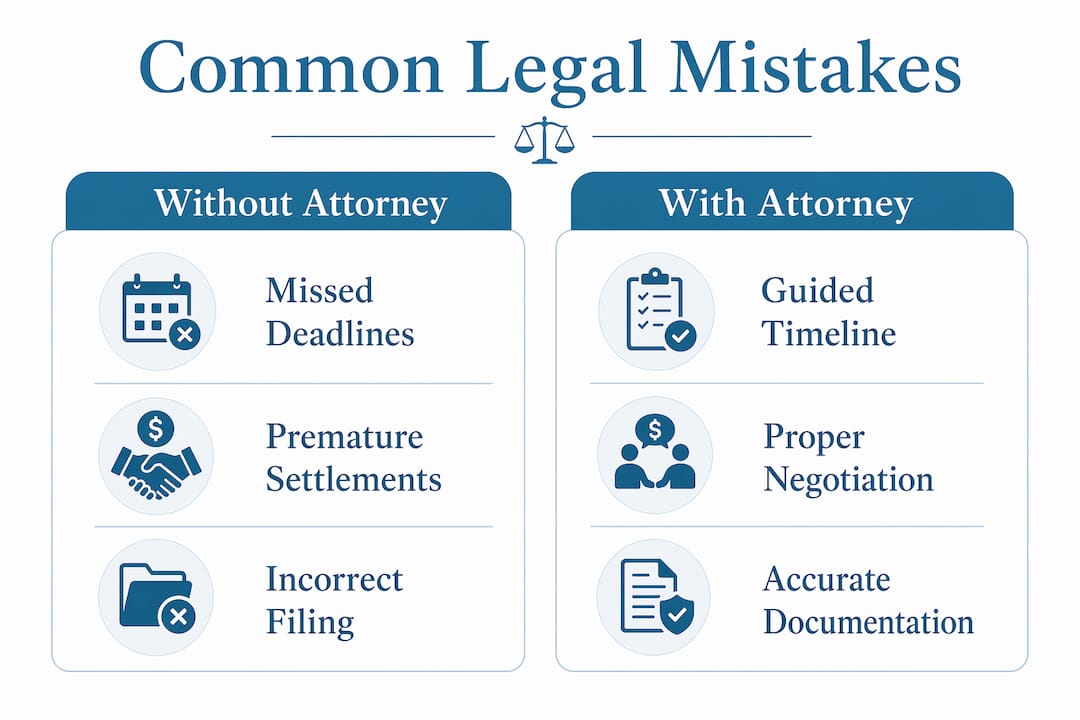
Statutes of limitations are strictly enforced in virtually every jurisdiction. Missing the filing window results in a total loss of recovery rights, with almost no exceptions. Courts do not grant extensions because you were unaware of the deadline or were still negotiating with the insurer.
Signing a final release is the most irreversible mistake in any personal injury claim. Premature settlement acceptance closes the claim completely, eliminating any possibility of future damages recovery even if your condition worsens significantly. Insurers know this and often push for early signatures before the full extent of injuries is clear.
Proving liability in complex cases, such as multi-vehicle accidents, premises liability, or product defect claims, requires understanding of negligence standards, comparative fault rules, and evidentiary requirements. Without legal training, self-represented claimants often accept partial blame they do not legally owe, which directly reduces their recovery under comparative negligence rules.
| Legal issue | Risk for self-represented claimants |
|---|---|
| Statute of limitations | Missing deadline eliminates all recovery rights permanently. |
| Final release signing | Closes claim forever, even for future medical complications. |
| Comparative fault | Claimants may accept more blame than the law assigns them. |
| Pain and suffering valuation | Non-economic damages are routinely undervalued or omitted entirely. |
Insurance adjusters are not neutral parties. They are trained professionals working to protect their employer's bottom line. Every tactic they use, from friendly early calls to fast settlement offers, is designed to close your claim for less than it is worth before you understand what you are entitled to receive.
Key takeaways
Self-represented injury claimants consistently recover less than represented claimants because cumulative procedural errors erode claim value at every stage.
| Point | Details |
|---|---|
| Medical treatment timing | Seek care within 72 hours to establish the causal link between accident and injury. |
| Recorded statements | Decline all recorded statements to the opposing insurer until you understand your rights. |
| Evidence preservation | Collect photos, police reports, and surveillance footage within 48 hours before it disappears. |
| Settlement evaluation | Never accept a first offer. Use a compensation calculator to benchmark fair value before negotiating. |
| Legal deadlines | Know your state's statute of limitations and treat it as a hard stop with no exceptions. |
What I've learned watching people handle claims alone
I have seen hundreds of injury claims come through Accidentsurvivalguide, and the pattern is almost always the same. People do not lose their claims in one dramatic moment. They lose them slowly, through a series of small decisions that each seem reasonable at the time.
The biggest myth I want to challenge is this: that handling your own claim saves you money because you avoid attorney fees. In reality, poor documentation and treatment gaps collectively erode claim credibility in ways that cost far more than any contingency fee would have. You end up paying the insurer's legal team with your own settlement money, just indirectly.
What I tell everyone who comes to us is this: even if you decide not to hire an attorney, consult one first. Most personal injury attorneys offer free initial consultations. That one conversation can tell you whether you are on the right track or about to make a mistake you cannot undo. The information is free. The cost of not getting it is not.
The other thing I have noticed is that insurance companies behave differently with unrepresented claimants. Not aggressively, necessarily. Politely. Helpfully, even. That friendliness is a tactic. The adjuster assigned to your file has one job, and it is not to make sure you are treated fairly.
— Scott
How Accidentsurvivalguide can help you protect your claim
If you are managing a personal injury claim on your own, you need accurate information before you make any decisions that cannot be reversed.
Accidentsurvivalguide offers a free Accident Compensation Calculator that helps you estimate what your claim may actually be worth based on your specific damages, including medical costs, lost wages, and pain and suffering. Before you respond to any settlement offer, run your numbers. The calculator takes minutes and gives you a concrete benchmark to negotiate from. Accidentsurvivalguide also publishes state-specific guides, including detailed resources for Virginia accident victims and Massachusetts residents, covering exactly what to do after an accident to protect your legal rights. If your situation is complex, connect with a legal professional through the site before you sign anything.
FAQ
What is the biggest mistake in a self-represented injury claim?
Accepting a settlement offer before the full extent of your injuries is known is the single most damaging error. Once you sign a final release, your claim is closed permanently, even if you require surgery or ongoing treatment later.
How long do I have to file a personal injury claim?
Most states allow up to two years from the date of injury, but government entity claims can require filing in as little as six months. Missing this deadline eliminates your right to recover any compensation, with virtually no exceptions.
Do I have to give a recorded statement to the insurance company?
You are not legally required to give a recorded statement to the other driver's insurer. Adjusters are trained to use casual remarks from these calls to reduce or deny claims, so it is best to decline until you have spoken with an attorney.
Can I negotiate a personal injury settlement without a lawyer?
Yes, but unrepresented claimants consistently recover less because they lack litigation leverage and do not know how to negotiate medical liens. An attorney consultation, even without full representation, can significantly improve your negotiating position.
How do I know if a settlement offer is fair?
A fair offer accounts for current medical bills, future treatment costs, lost wages, and non-economic damages like pain and suffering. Use a compensation calculator as a baseline and compare the offer against your documented total losses before responding.