
Medical documentation after a recent accident is the primary evidence that connects your injuries to the crash, determines your treatment path, and directly shapes the outcome of any insurance or legal claim you file. Over 70% of personal injury verdicts are most strongly influenced by medical records, and comprehensive documentation leads to 35% faster settlements. That single fact explains why your records are not just paperwork. They are your case. Attorney John J. Malm states there is no such thing as too much medical documentation, and that thorough records prevent insurers from minimizing what you suffered.
What medical documentation is essential after a recent accident
The accident documentation process begins the moment you receive care, and every record generated from that point forward carries legal and medical weight. Emergency room intake notes create an official baseline documenting your injuries, vital signs, symptoms, and immediate treatment. These records are often the first thing an insurance adjuster or attorney reviews, so their accuracy and completeness set the tone for everything that follows.
The core documents you need to collect and preserve include:
- Emergency room records: Triage notes, discharge summaries, and attending physician assessments from your initial visit
- Imaging reports: Dated X-rays, MRIs, and CT scans with written interpretations from radiologists
- Ambulance and paramedic reports: Scene-level observations that document your condition before hospital arrival
- Physician and specialist notes: Diagnoses, treatment plans, and symptom descriptions from every provider you see
- Physical therapy and rehabilitation records: Progress notes that show the ongoing impact of your injuries over time
- Prescription and medication records: Pharmacy records that document what was prescribed, when, and for how long
- Referral and follow-up documentation: Any specialist referrals or scheduled follow-ups that show continuity of care
Each document type serves a distinct purpose. Imaging reports prove structural damage. Therapy records prove functional impairment. Prescription records prove ongoing pain management. Together, they build a complete picture that no single document can create alone.
Pro Tip: Request copies of every record at each visit rather than waiting until you need them for a claim. Providers can take weeks to fulfill records requests, and delays can stall your case at a critical moment.

Why timing and consistency in seeking care matter
Seeking a medical evaluation within 24 to 48 hours after an accident is not optional if you want to protect both your health and your claim. Injuries like internal trauma, soft tissue damage, and concussions often do not produce obvious symptoms immediately. Waiting even a few days gives insurance companies a factual argument that your injuries were not serious or were caused by something else entirely.
Here is why a consistent, documented care timeline protects you:
- Establishes temporal causation. Medical records dated close to the accident date directly link your injuries to the event. A two-week gap invites dispute.
- Prevents the "gap in care" argument. Insurance adjusters scrutinize medical records for missed appointments and delays in treatment to argue that your injuries were not severe enough to require consistent care.
- Documents symptom progression. Consistent follow-up visits create a record of how your condition evolved, which is critical for proving long-term or worsening injuries.
- Supports your credibility. A patient who attends every follow-up and reports symptoms consistently is far more credible to a jury or adjuster than one with sporadic care.
- Protects your recovery. Beyond legal strategy, consistent care simply produces better health outcomes. Missed appointments mean missed treatment.
Attorney Carla D. Aikens notes that insurance companies analyze medical records closely, looking for inconsistencies to weaken claims. The most common inconsistency they find is a gap between the accident date and the first medical visit. Do not give them that opening.
Maintaining a daily pain log provides contemporaneous evidence that medical notes sometimes miss. Write down your symptoms, pain levels, and how your injuries affect your daily activities every single day. This log can fill gaps between appointments and counter an insurer's attempt to minimize your suffering.
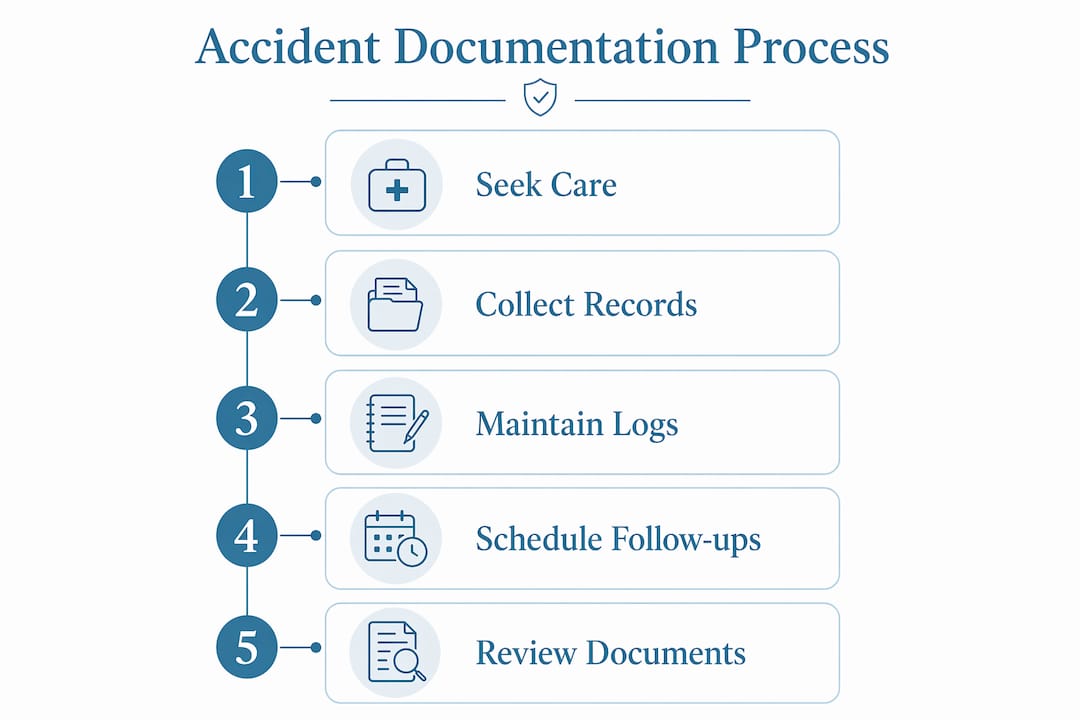
Pro Tip: Set a phone reminder for every scheduled medical appointment and every day you write in your symptom log. Consistency is the single most powerful thing you can do for your claim outside of the doctor's office.
How electronic health records have changed accident documentation
The shift to digital recordkeeping has fundamentally changed what medical documentation after accidents looks like and how accessible it is. 78% of office-based physicians and 96% of non-federal acute care hospitals in the U.S. now use certified Electronic Health Record (EHR) systems. That near-universal adoption means your records are almost certainly stored digitally, which creates both advantages and responsibilities for you as a patient.
| EHR benefit | What it means for accident victims |
|---|---|
| Instant accessibility | Records can be shared between providers and attorneys faster than paper ever allowed |
| Audit trail | Every entry is timestamped and attributed, making records harder to dispute or alter |
| Care coordination | Multiple specialists treating you can view the same record, reducing errors and gaps |
| AI-assisted notes | Modern EHR platforms use predictive analytics and real-time alerts to flag missing information |
| Reduced loss risk | Digital records do not get lost in a file room or destroyed in a flood |
The practical implication for you is straightforward. Request access to your patient portal immediately after any accident-related visit. Most major EHR systems, including Epic and Cerner, offer patient portals where you can view, download, and share your records directly. Do not wait for a formal records request to discover that a note is missing or inaccurate.
Dr. Volker Hitzeroth explains that medical records are the only representation of a patient's condition available during legal proceedings when patients are absent or memories fade. Years after your accident, your records will speak for you. Make sure they say the right things.
Common pitfalls in accident medical documentation
The most damaging documentation mistakes are not the ones victims know about. They are the quiet omissions that seem harmless at the time but hand insurance companies exactly the ammunition they need.
- Failing to state the cause of your symptoms. Explicitly telling every provider that your symptoms are due to the recent accident is the single most critical step most victims skip. If your records say "neck pain" without linking it to the crash, insurers argue it is a pre-existing condition.
- Downplaying symptoms to your doctor. Patients often minimize pain out of habit or stoicism. If you rate your pain a 3 out of 10 when it is genuinely a 7, that number lives in your record forever.
- Skipping follow-up appointments. A single missed appointment creates a gap that adjusters will highlight. If you must reschedule, do so immediately and document the reason.
- Ignoring minor symptoms. Headaches, tingling, and mild dizziness after a crash can signal serious conditions like traumatic brain injury or nerve damage. Report every symptom, no matter how small it seems.
- Assuming non-clinical records do not count. Pharmacy receipts, over-the-counter medication purchases, and even rideshare receipts to medical appointments all support your claim. Keep everything.
- Not reviewing your discharge summary. Patients should review discharge summaries and correct inaccuracies immediately. Later corrections are difficult to make and errors can seriously weaken your claim.
The common mistakes people make after a car crash extend well beyond the accident scene. Documentation errors made in the first weeks of treatment are among the most costly and the hardest to fix.
Pro Tip: Before you leave any medical appointment, ask the provider to confirm in the notes that your symptoms are related to your accident. A single sentence in the record stating "patient presents with injuries sustained in motor vehicle accident on [date]" can be worth thousands of dollars to your claim.
How to organize and present your medical records effectively
Collecting records is only half the work. Organizing them so they tell a clear, chronological story of your injury is what actually moves a claim forward.
- Collect records from every provider. This includes the ER, every specialist, your primary care physician, physical therapists, chiropractors, and your pharmacy. Leave no provider out.
- Create a master folder with physical and digital copies. Organize documents by date and provider. Use a cloud storage service like Google Drive or Dropbox so records are accessible from anywhere and cannot be lost.
- Build a medical chronology. Organizing records into a clear timeline clarifies injury progression and causation, which directly improves how your claim is presented to insurers or a jury.
- Work with a personal injury attorney early. Attorneys experienced in accident claims know exactly which records carry the most weight and can identify gaps before they become problems. They can also subpoena records you cannot obtain on your own.
- Keep a personal symptom journal alongside your clinical records. Your daily log of pain levels, functional limitations, and emotional impact supplements the clinical picture and provides evidence that medical notes sometimes miss.
- Share records carefully and strategically. Do not send your full medical history to an insurance company without legal guidance. Share only what is directly relevant to the accident and only after an attorney has reviewed it.
Understanding why early medical evaluation matters for proving the link between an accident and your injuries is the foundation of every step above. The earlier you start building your record, the stronger your position becomes.
Key takeaways
Comprehensive, timely medical documentation is the single most powerful tool an accident victim has to protect both their health and their legal claim.
| Point | Details |
|---|---|
| Start documentation immediately | Seek care within 24 to 48 hours and collect records from every provider from day one. |
| State the accident cause explicitly | Tell every provider your symptoms are from the accident so the causation link appears in every record. |
| Maintain consistent care | Gaps in treatment give insurers grounds to dispute injury severity and reduce compensation. |
| Use EHR patient portals | Access and review digital records promptly to catch errors before they damage your claim. |
| Organize into a chronology | A dated, provider-by-provider timeline tells your injury story clearly to adjusters and attorneys. |
What I have learned about documentation after going through it myself
I have seen firsthand how a well-documented injury claim and a poorly documented one can produce wildly different outcomes for people who suffered the same type of accident. The difference almost never comes down to the severity of the injury. It comes down to the paper trail.
The pattern I see most often is victims who feel fine in the first 48 hours and decide to "wait and see." By the time symptoms worsen, they have already handed the insurance company a two-week gap to exploit. Insurers do not need to prove you were not hurt. They only need to create enough doubt to justify a lower offer. A gap in care does exactly that.
What I tell every accident victim is this: start your documentation on day one and treat it like a second job until your case is resolved. Write in your symptom journal every night. Attend every appointment. Tell every doctor, every time, that your symptoms are from the accident. Review every discharge summary before you leave the building. These are not complicated steps. They are just disciplined ones, and most people skip them because nobody told them how much it would matter later.
Insurance companies have entire teams trained to find weaknesses in your documentation. Your job is to give them nothing to work with. The victims who do that consistently are the ones who get fair settlements. The ones who do not often regret it for years.
— Scott
Get the support you need after your accident
Dealing with medical records, insurance companies, and legal questions after an accident is genuinely overwhelming, especially when you are also trying to heal. Accidentsurvivalguide was built specifically for this moment.
The site offers free, practical guidance on every step of the post-accident process, from what to do in the first 24 hours to how to handle insurance tactics designed to minimize your claim. You will find checklists, plain-language explanations of your rights, and connections to experienced legal professionals nationwide. Visit Accident Survival Guide to access resources that help you protect yourself, stay organized, and make informed decisions before you sign anything or accept any offer.
FAQ
Why does medical documentation matter so much for accident claims?
Medical records influence over 70% of personal injury verdicts and lead to 35% faster settlements when comprehensive. They are the objective proof that connects your injuries to the accident, which is the foundation of any successful claim.
How soon should I see a doctor after an accident?
Seek a medical evaluation within 24 to 48 hours even if you feel fine. Delayed care creates a gap that insurers use to argue your injuries were not caused by the accident or were not serious.
What happens if I have gaps in my medical treatment?
Insurance adjusters treat gaps in care as evidence that your injuries were not severe enough to require consistent treatment. Even a short break in appointments can be used to reduce your settlement offer or dispute causation entirely.
Do I need to tell my doctor the accident caused my symptoms?
Yes, every single time. Explicitly stating to each provider that your symptoms are from the accident creates the causation link in your records that is required for a successful insurance or legal claim.
Can I correct errors in my medical records after the fact?
You can request corrections, but errors should be caught and corrected immediately after each visit. Later amendments are harder to make and may raise credibility questions, so review every discharge summary before you leave the facility.