
Truck accident injury compensation is the legal process of recovering economic and non-economic losses after a crash involving a commercial vehicle, covering everything from emergency medical bills to long-term disability and lost earning capacity. This guide exists because truck accident claims are fundamentally different from standard car accident claims. Commercial carriers carry federal insurance minimums of $750,000 for general freight, $1 million for oil and hazardous materials, and $5 million for other hazardous cargo. Those figures create a much higher compensation ceiling than a typical auto policy, but only if you know how to build and file your claim correctly.
What evidence do you need to file a truck accident injury claim?
The foundation of any successful truck injury claim is documentation gathered in the days and weeks immediately after the crash. Insurers and defense attorneys look for gaps in evidence to justify lower offers. Your job is to give them no gaps.
The most critical categories of evidence include:
- Medical records and treatment documentation: Every ER visit, specialist appointment, physical therapy session, and prescription must be recorded. Objective medical proof is the single strongest driver of claim value, because it converts subjective pain into quantifiable loss.
- Police and accident scene reports: The official crash report establishes fault narratives and records witness information. Request it within 24 to 48 hours before details get amended.
- Electronic Logging Device (ELD) and Hours-of-Service (HOS) data: Federal law requires commercial trucks to record driving hours electronically. HOS data analyzed alongside dispatch records can reveal driver fatigue and schedule falsification, providing evidence that goes far beyond assumptions.
- Witness statements: Collect names, phone numbers, and written or recorded statements from anyone who saw the crash.
- Maintenance and inspection records: Brake failures, tire blowouts, and load-securing violations often trace back to the carrier's maintenance logs.
The single most time-sensitive step is sending a spoliation letter to the trucking company demanding preservation of all electronic data. ELD records, onboard camera footage, and GPS telematics can be overwritten within days under standard data retention cycles. Once that data is gone, it is gone.
Pro Tip: Send a spoliation demand letter through a licensed attorney within 72 hours of the accident. Courts treat destruction of evidence after a preservation demand as spoliation, which can shift the burden of proof in your favor.

Truck accidents also frequently involve multiple liable parties, including the driver, the carrier, freight brokers, and equipment manufacturers. Early investigation clarifies which parties carry coverage and prevents insurers from deflecting responsibility onto each other later. The Accidentsurvivalguide resource on employer liability covers this multi-party dynamic in detail.
How do statutes of limitations affect your compensation claim?
Legal deadlines are the most unforgiving aspect of personal injury settlements. Miss the filing window and your claim is dismissed regardless of how strong your evidence is.
Here is how the timeline works in practice:
- Standard two-year limit: Most states, including Texas and Arizona, set a two-year statute of limitations from the date of the accident for personal injury claims. That sounds like plenty of time, but building a trial-ready case takes months.
- Government vehicle exceptions: If the truck was operated by a government agency, you may need to file an administrative notice of claim within 90 to 180 days. Missing this shorter window bars your lawsuit entirely.
- Minor victims: The clock typically does not start running for injured minors until they reach the age of majority, though rules vary by state.
- Discovery rule: In some cases where injuries are not immediately apparent, the statute begins when you reasonably discovered the injury, not the crash date itself.
- Negotiation vs. lawsuit deadlines: Insurance negotiations have no fixed deadline, but your leverage disappears the moment the statute expires. Insurers know this and sometimes stall deliberately.
The practical consequence of missing a deadline is total case dismissal. No settlement, no trial, no recovery. Contact a personal injury attorney as early as possible, ideally within the first two weeks after the accident, so they can calendar all applicable deadlines and begin evidence preservation simultaneously.
What types of compensation can you receive after a truck crash?
Truck accident claims cover three categories of damages, and understanding each one determines how you build your demand package.
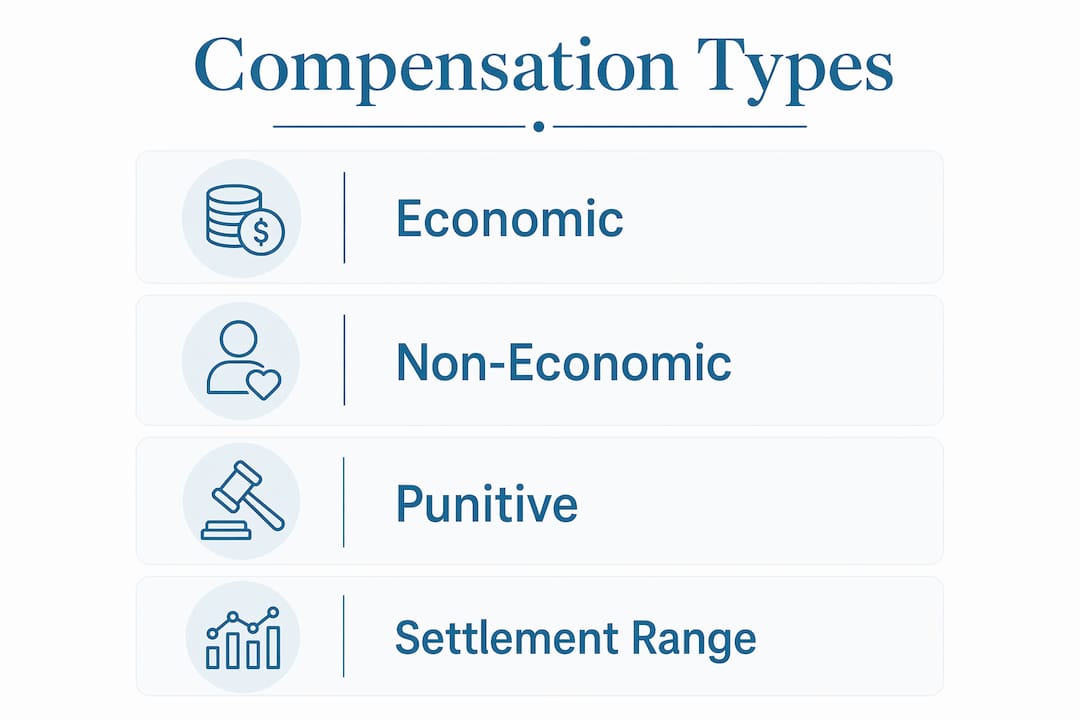
Economic damages are the easiest to calculate because they have receipts attached. They include current and future medical bills, lost wages during recovery, reduced earning capacity if you cannot return to your previous job, and costs for home care or vehicle modifications. Future care costs are particularly significant. A life-care plan prepared by a medical expert can project decades of treatment needs, and that projection materially increases claim value.
Non-economic damages cover pain and suffering, emotional distress, loss of enjoyment of life, and loss of consortium for affected family members. These are harder to quantify, so attorneys typically apply a multiplier of 1.5x to 5x against your economic damages depending on injury severity. In no-fault states like New York, recovering pain and suffering requires satisfying a statutory serious injury threshold, which makes thorough medical documentation even more critical in those jurisdictions.
Punitive damages apply in cases of gross negligence, such as a carrier knowingly putting a fatigued or unlicensed driver on the road. They are not available in every case but can multiply the total award significantly when courts find willful misconduct.
The table below shows typical settlement ranges by injury severity, based on 2025 to 2026 law firm data:
| Injury severity | Typical settlement range | Key value drivers |
|---|---|---|
| Minor (soft tissue, short recovery) | $50,000 to $150,000 | Medical bills, short-term lost wages |
| Moderate (fractures, surgery required) | $150,000 to $500,000 | Surgical costs, extended lost income |
| Severe (TBI, spinal injury, amputation) | $500,000 to $2,000,000+ | Future care plans, permanent disability |
| Wrongful death | $1,000,000+ | Survivor losses, punitive potential |
These settlement value ranges are illustrative, not guaranteed. The actual figure depends on liability clarity, available insurance coverage, and the quality of your documentation. Because FMCSA-regulated carriers carry higher insurance minimums than standard auto policies, the negotiation floor is substantially higher from the start.
How to file a truck accident injury claim step by step
Filing a claim correctly is as important as the evidence behind it. A disorganized claim signals weakness to an adjuster and invites lowball offers.
- Notify all relevant insurers immediately. Contact your own insurer and the trucking company's carrier within days of the accident. Delay can be used as a reason to question the severity of your injuries.
- File for Personal Injury Protection (PIP) benefits if you live in a no-fault state. PIP covers initial medical costs regardless of fault and keeps your treatment funded while liability is disputed.
- Send a preservation demand to the trucking company. As covered above, this must happen fast. Your attorney should handle this on day one.
- Build a synchronized demand package. A demand package combining crash evidence, medical timelines, liability theories, and itemized losses is evaluated far more favorably by insurers than a simple letter requesting payment. Every receipt, every appointment, every missed workday should be documented and organized chronologically.
- Negotiate with adjusters strategically. Adjusters are trained to minimize payouts. Never accept a first offer without reviewing it with an attorney. The first offer is almost always below the claim's actual value.
- Consider litigation when negotiations stall. Filing a lawsuit does not mean going to trial. Most cases settle after a lawsuit is filed because it signals you are prepared to fight. Your attorney can advise on when filing creates the most leverage.
Pro Tip: Keep a daily injury journal from the day of the accident. Record your pain levels, limitations, emotional state, and how the injury affects daily activities. Judges and juries respond to specific, dated personal accounts far more than general descriptions of suffering.
The settlement process explained on Accidentsurvivalguide walks through each negotiation stage in detail, which is worth reading before your first call with an adjuster.
Key takeaways
Truck accident injury compensation claims succeed when evidence is preserved early, deadlines are respected, and damages are documented with precision across all three categories.
| Point | Details |
|---|---|
| Preserve electronic evidence fast | Send a spoliation letter within 72 hours to secure ELD, HOS, and camera data before it is overwritten. |
| Know your filing deadline | Most states allow two years from the accident date; government vehicle claims may require notice within 90 days. |
| Document all three damage types | Economic, non-economic, and punitive damages each require different proof and increase total claim value. |
| Higher insurance minimums matter | FMCSA minimums of $750,000 to $5 million create a higher negotiation floor than standard auto claims. |
| Build a synchronized demand package | Organized timelines of medical records and losses produce better insurer evaluations and higher settlements. |
What I've learned watching victims leave money on the table
Scott here. After going through a serious accident myself and spending years building Accidentsurvivalguide with Kathy, I have seen the same pattern repeat itself more times than I can count. People who were genuinely hurt, with real losses and legitimate claims, walked away with a fraction of what they deserved. Not because their cases were weak. Because they made avoidable mistakes in the first 30 days.
The biggest one is talking to the trucking company's insurer without an attorney present. Adjusters are skilled at asking questions that sound sympathetic but are designed to get you to minimize your injuries on record. "How are you feeling today?" is not small talk. It is a documented statement.
The second mistake is waiting. I understand the instinct. You are in pain, you are overwhelmed, and dealing with lawyers feels like one more thing. But evidence disappears fast. Witnesses forget details. ELD data gets overwritten. The trucking company's legal team starts building their defense the day of the crash. You need to start building yours just as quickly.
The third mistake is accepting the first offer out of financial desperation. Medical bills pile up, income stops, and a check for $40,000 feels like relief. But for a moderate injury with surgery and six months of lost work, that number is often less than a third of fair value. Once you sign a release, you cannot go back.
My honest advice: get a personal injury attorney who specializes in commercial truck cases on the phone within the first week. Most work on contingency, meaning no upfront fees. The consultation is free. The cost of not calling is not.
— Scott
How Accidentsurvivalguide can help you right now

Accidentsurvivalguide was built specifically for moments like this. The platform provides free, plain-language guidance on what to do after a truck accident, covering evidence preservation, insurance tactics, medical documentation, and your legal rights. Founded by Scott Tischler and Kathy Carr after their own accident experiences, the site connects victims with experienced legal professionals nationwide at no upfront cost. Attorneys in the network work on contingency, so you pay nothing unless you win. If you are in Texas, the Texas accident resource provides state-specific guidance on filing timelines and local legal requirements. Do not wait until the statute of limitations is weeks away. The earlier you act, the stronger your claim.
FAQ
What is the average truck accident settlement amount?
Truck accident settlements range from roughly $50,000 for minor injuries to over $2 million for severe or permanent injuries. Wrongful death claims frequently exceed $1 million depending on survivor losses and available coverage.
How long do I have to file a truck accident injury claim?
Most states set a two-year statute of limitations from the accident date, though exceptions exist for minors, delayed injury discovery, and government-owned vehicles. Missing the deadline results in permanent case dismissal.
Can I recover compensation if the truck driver was fatigued?
Yes. Hours-of-Service violations and ELD data showing fatigue are strong evidence of negligence against both the driver and the carrier. Courts treat schedule falsification as gross negligence, which can support punitive damages.
Who can be held liable in a truck accident claim?
Multiple parties can share liability, including the truck driver, the motor carrier, freight brokers, cargo loaders, and equipment manufacturers. Early investigation is required to identify all responsible parties before coverage disputes arise.
Do I need an attorney to file a truck accident claim?
You are not legally required to hire an attorney, but truck accident claims involve federal regulations, multiple insurers, and complex evidence that most individuals are not equipped to handle alone. An experienced personal injury attorney typically recovers significantly more than unrepresented claimants, and most charge no fee unless your case settles or wins at trial.