
Auto accident victims in Spain hold the legal right to claim full compensation for personal injuries and material damages directly from the responsible party's insurer, regardless of who was driving. These rights are defined under Spanish law, including Ley 35/2015 and the Baremo valuation system, which set the framework for every traffic injury claim in the country. The derechos victimas accidente auto are broader than most people realize. They cover lost income, future rehabilitation costs, emotional trauma, and more. Knowing these rights before you speak to any insurer is the single most important step you can take.
1. What are the legal rights of auto accident victims in Spain?
Auto accident victims in Spain have the right to claim compensation directly from the at-fault driver's insurance company under Article 76 of the Law of Insurance Contract. This means you claim against the insurer, not the individual driver. That distinction matters because insurers have legal obligations and deadlines that individual drivers do not.
The Baremo system, updated by Ley 35/2015, is the official framework for calculating injury compensation in Spain. It classifies damages into personal injuries, psychological harm, aesthetic damage, and financial losses. Every claim in Spain runs through this system, which means your compensation is calculated by a defined set of rules, not an insurer's discretion.

Your rights also include the right to receive a formal, written settlement offer from the insurer. That offer must be reasoned and specific. If the insurer refuses or the offer is inadequate, you have the right to pursue judicial action.
2. What compensation can victims claim after an auto accident?
Compensation for auto accident victims in Spain falls into two main categories: personal damages and financial damages. Personal damages cover physical injuries, psychological harm, and aesthetic changes such as scarring. Financial damages cover everything from medical bills to lost wages and future care costs.
The Baremo system further divides personal damages into basic and particular injuries. Basic injuries apply to everyone with the same type of harm. Particular injuries account for how the injury specifically affects your life, your profession, or your daily activities. A surgeon who loses partial hand function receives a higher particular injury award than someone whose profession is unaffected.
Future patrimonial damages are one of the most overlooked categories. These cover chronic treatment, rehabilitation, prosthetics, and ongoing medical needs that arise years after the accident. Legal experts confirm these are fully compensable but frequently left out of early settlement offers.
| Damage Category | What It Covers |
|---|---|
| Basic personal injury | Physical pain, hospitalization, recovery period |
| Particular personal injury | Impact on profession, daily life, personal relationships |
| Aesthetic damage | Scarring, disfigurement, visible physical changes |
| Medical and transport costs | Hospital bills, therapy, ambulance, travel to appointments |
| Lost income (lucro cesante) | Wages lost during recovery or due to reduced work capacity |
| Future care costs | Rehabilitation, prosthetics, chronic treatment needs |
Pro Tip: Request an itemized breakdown of every damage category from your attorney before accepting any offer. Insurers rarely volunteer the full picture of what you can claim.
3. How and when should victims file a compensation claim?
The prescriptive period for filing a compensation claim in Spain is one year from injury stabilization, not from the accident date. Injury stabilization means the point at which your medical condition has reached its maximum improvement. Missing this deadline forfeits your right to compensation entirely.
Before filing any lawsuit, you must first submit your claim to the insurer. This is a legal requirement under Spanish law, known as the requisito de procedibilidad. Once you submit the claim, the insurer has three months to provide a motivated compensation offer in writing. If the offer is insufficient or the insurer fails to respond, you can then proceed to court.
The steps to protect your claim from day one are clear:
- Seek medical attention within 72 hours of the accident. Soft-tissue injuries like whiplash are routinely denied without medical records from this window.
- Request the official police report, known as the atestado, especially if liability is disputed or injuries are serious.
- Collect photos of the scene, vehicle damage, and your injuries as soon as possible.
- Gather contact information from all witnesses present.
- Keep every medical record, prescription, and receipt related to the accident.
- Submit your formal claim to the insurer in writing, with all supporting documentation attached.
- Wait for the motivated offer before making any decisions about settlement.
Pro Tip: Never sign any document from the insurer without having a lawyer review it first. What looks like a routine form may be a release of future rights.
4. Who has the right to claim compensation after a traffic accident?
All individuals involved in a traffic accident in Spain have the right to claim compensation, provided they are not solely responsible for the accident. This includes a wider group than most people assume.
The following individuals can file a claim:
- Drivers not at fault. If another driver caused the accident, you have a direct right to claim against their insurer.
- Vehicle passengers. Passengers can always claim, regardless of which driver was at fault.
- Pedestrians. Any pedestrian struck by a vehicle has full compensation rights under Spanish law.
- Cyclists and personal mobility vehicle users. Riders of bicycles and electric scooters (VMP) are covered under the same framework.
- Victims of uninsured or hit-and-run drivers. The Consorcio de Compensación de Seguros, a state-backed fund, covers these cases when no insurer can be identified.
Contributory negligence does affect the final amount. If you were partially at fault, your compensation is reduced proportionally. But partial fault does not eliminate your rights. Even a victim who was 30% responsible retains the right to claim 70% of their calculated damages.
5. Your rights when the other driver has no insurance
Victims of uninsured drivers are not left without recourse in Spain. The Consorcio de Compensación de Seguros steps in as the payer of last resort for accidents caused by uninsured vehicles or unknown drivers. This is one of the most important protections in the Spanish system and one of the least known.
The process for claiming through the Consorcio follows the same Baremo rules as a standard insurer claim. You submit documentation, the Consorcio assesses the damages, and it issues a motivated offer. The timeline and legal requirements are identical to a normal claim. The key difference is that you direct your claim to the Consorcio rather than a private insurer.
Derechos victimas accidente sin seguro are fully protected under this system. You do not need to locate or sue the uninsured driver personally to receive compensation. The Consorcio handles the financial obligation and may later pursue the uninsured driver independently.
6. Common mistakes that reduce your compensation
Accepting an early settlement is the single most damaging mistake a victim can make. Insurers are motivated to close files quickly and at the lowest possible cost. Early settlement releases, known as finiquito agreements, permanently waive your right to future compensation even if your injuries worsen significantly.
Other costly errors include:
- Skipping medical care in the first 72 hours. Without early medical records, insurers deny soft-tissue injury claims as unrelated to the accident.
- Failing to request the atestado. The official police report carries decisive weight in any liability dispute. A friendly accident report is not sufficient for serious or contested cases.
- Underestimating long-term damages. Victims routinely accept settlements that cover only immediate costs, ignoring future rehabilitation, lost earning capacity, and emotional trauma.
- Not documenting non-economic harm. Psychological damage, loss of enjoyment of life, and impact on personal relationships are all compensable under the Baremo system.
- Assuming you must sue the driver directly. Spanish law requires you to claim against the insurer first. Suing the driver directly without first submitting an insurer claim is procedurally invalid.
"The insurance system is built to close claims fast. Your job is to slow down, document everything, and wait until your injuries have fully stabilized before you agree to anything."
For a detailed breakdown of the most costly post-accident errors, Accidentsurvivalguide has published practical guides covering exactly these scenarios.
Key Takeaways
Auto accident victims in Spain have the legal right to claim full compensation from the responsible party's insurer, covering personal injuries, financial losses, and future care costs, under Ley 35/2015 and the Baremo system.
| Point | Details |
|---|---|
| Claim against the insurer, not the driver | Spanish law requires victims to file with the insurer first before any court action. |
| One-year deadline from stabilization | The prescriptive period starts when injuries stabilize, not on the accident date. |
| 72-hour medical window is critical | Soft-tissue injury claims are routinely denied without records from this period. |
| Uninsured victims are protected | The Consorcio de Compensación de Seguros covers claims against uninsured or unknown drivers. |
| Never sign a finiquito early | Signing a release before full injury assessment permanently waives future compensation rights. |
What I have learned about fighting for fair compensation in Spain
After years of working with accident victims and building Accidentsurvivalguide alongside Kathy Carr, the pattern I see most often is not ignorance of rights. It is the pressure to act before you are ready.
Insurers in Spain are professional claim closers. They send adjusters quickly, they make offers that sound reasonable, and they use language that implies the offer is final. It is not. The motivated offer is a starting point, not a ceiling. Every victim I have seen accept the first offer has left money on the table, sometimes a significant amount.
The atestado is underused. Victims assume a friendly accident report is enough. In a simple fender bender with no injuries, it may be. But the moment injuries are involved or liability is disputed, the atestado is the document that decides the case. Insist on it. If police did not attend the scene, file a report yourself and document everything photographically within hours.
The finiquito is the most dangerous document in the Spanish claims process. It looks like a receipt. It functions as a permanent waiver. I have spoken with victims who signed one within weeks of an accident, only to discover months later that their injuries required surgery. Their rights were gone. Wait until your doctor formally declares your injuries stabilized. Then, and only then, consider any settlement.
The legal rights of auto accident victims in Spain are genuinely strong. Ley 35/2015 and the Baremo system give victims a structured, enforceable path to fair compensation. The system works when you use it correctly and refuse to be rushed.
— Scott
Accidentsurvivalguide can help you estimate your claim
Understanding your rights is the first step. Knowing what your claim is actually worth is the next one.
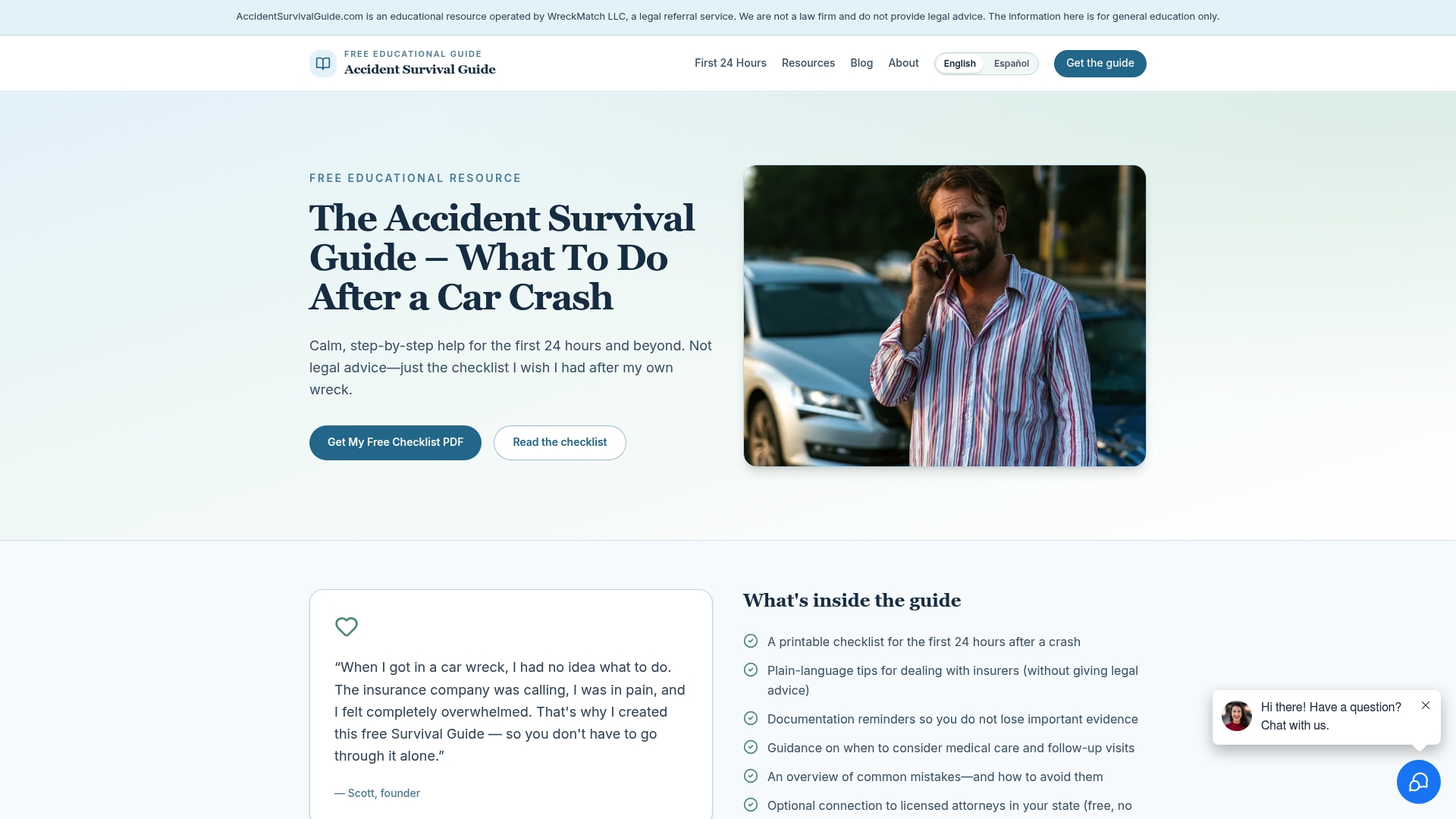
Accidentsurvivalguide offers a free accident compensation calculator updated for 2026 that helps you estimate the value of your claim based on injury type, financial losses, and long-term damages. The tool is built for victims who want a clear picture of what they are owed before speaking with any insurer. You can also find practical guidance on common mistakes that reduce compensation, so you go into the process informed and protected. No legal jargon. No pressure. Just clear information when you need it most.
FAQ
Who can claim compensation after a car accident in Spain?
Drivers not at fault, all passengers, pedestrians, cyclists, and personal mobility vehicle users can all claim compensation. Victims of uninsured or hit-and-run drivers can claim through the Consorcio de Compensación de Seguros.
How long do I have to file a car accident claim in Spain?
Victims have one year from the date their injuries stabilize to file a compensation claim. Missing this deadline permanently forfeits the right to compensation.
Do I need to sue the driver to get compensation?
No. Spanish law requires victims to claim directly against the responsible party's insurer before any court action. Suing the driver directly without first submitting an insurer claim is not procedurally valid.
What happens if I accept the insurer's first offer?
Accepting an early settlement, known as a finiquito, permanently waives your right to future compensation. If your injuries worsen after signing, you cannot claim additional damages.
What if the other driver had no insurance?
The Consorcio de Compensación de Seguros, a state-backed fund, covers compensation claims against uninsured or unidentified drivers in Spain. The same Baremo rules and claim procedures apply.