
Business vehicle accident victim rights are the legal entitlements injured parties hold to pursue compensation for medical costs, lost wages, pain and suffering, and property damage when harmed by a commercially operated or company-owned vehicle. These rights extend well beyond what applies in a typical two-car collision. Under tort law and federal motor carrier regulations, victims can pursue claims against multiple parties simultaneously, including the driver, the employer, the vehicle owner, and even third-party maintenance contractors. Texas and Florida laws both recognize this multi-party liability framework, making it a widely applicable standard across the country. Understanding these rights from the moment of impact is the first step toward protecting your financial recovery.
Who can be held liable in a business vehicle accident?
Commercial vehicle accident liability is fundamentally different from a standard car crash because the web of responsible parties is far wider. In a personal vehicle accident, liability typically falls on one driver. In a business vehicle crash, the law recognizes that a company's choices, from hiring to vehicle maintenance, directly contribute to the risk on the road.
The doctrine of respondeat superior, which is Latin for "let the master answer," holds that employers bear legal responsibility when their employees cause harm while performing job duties. This applies to delivery drivers, sales representatives driving company cars, and long-haul truckers operating fleet vehicles. The employer cannot simply point to the driver and walk away.
Beyond the employer and driver, other parties may share fault:
- Vehicle owners who lease trucks or vans to businesses without proper safety checks
- Cargo loading companies whose improper loading causes a vehicle to tip or lose control
- Maintenance contractors who failed to repair brakes, tires, or steering systems
- Vehicle manufacturers when a defective part contributes to the crash
- Staffing agencies that placed an unqualified driver behind the wheel
This multi-party structure creates real compensation advantages. Each liable party typically carries its own insurance policy, which means the total available coverage can be substantially higher than in any single-driver claim. FMCSA regulations require commercial motor carriers to carry minimum liability insurance of $750,000, and many large fleets carry policies in the millions. That regulatory floor does not exist for personal vehicles.
Pro Tip: Request the employer's full insurance declarations page early in your claim. Fleet policies often include umbrella coverage that significantly raises the compensation ceiling beyond the base policy limit.
Investigating employer hiring and training practices can also reveal negligent entrustment, meaning the company knowingly put an unqualified or unsafe driver on the road. That finding can support punitive damages in addition to compensatory ones.

What types of compensation can you claim after a business vehicle crash?
Victims in commercial vehicle accident claims can pursue two broad categories of damages: economic and non-economic. A third category, punitive damages, applies in cases involving reckless or intentional misconduct.
Economic damages are the most straightforward to calculate:
- Medical expenses, including emergency care, surgery, hospitalization, physical therapy, and future treatment costs
- Lost wages for time missed from work during recovery
- Diminished earning capacity if your injuries permanently reduce your ability to work
- Property damage for your vehicle and any personal belongings destroyed in the crash
Non-economic damages cover the human cost of the accident. Pain and suffering, emotional distress, loss of enjoyment of life, and loss of consortium for a spouse are all recognized categories in most states. These damages are harder to quantify but often represent the largest portion of a settlement in serious injury cases.
Commercial vehicle policy limits commonly range from hundreds of thousands to millions of dollars, which means the settlement potential in these cases far exceeds what most personal vehicle claims can reach. That higher ceiling matters most when injuries are catastrophic, such as spinal cord damage, traumatic brain injury, or permanent disability.
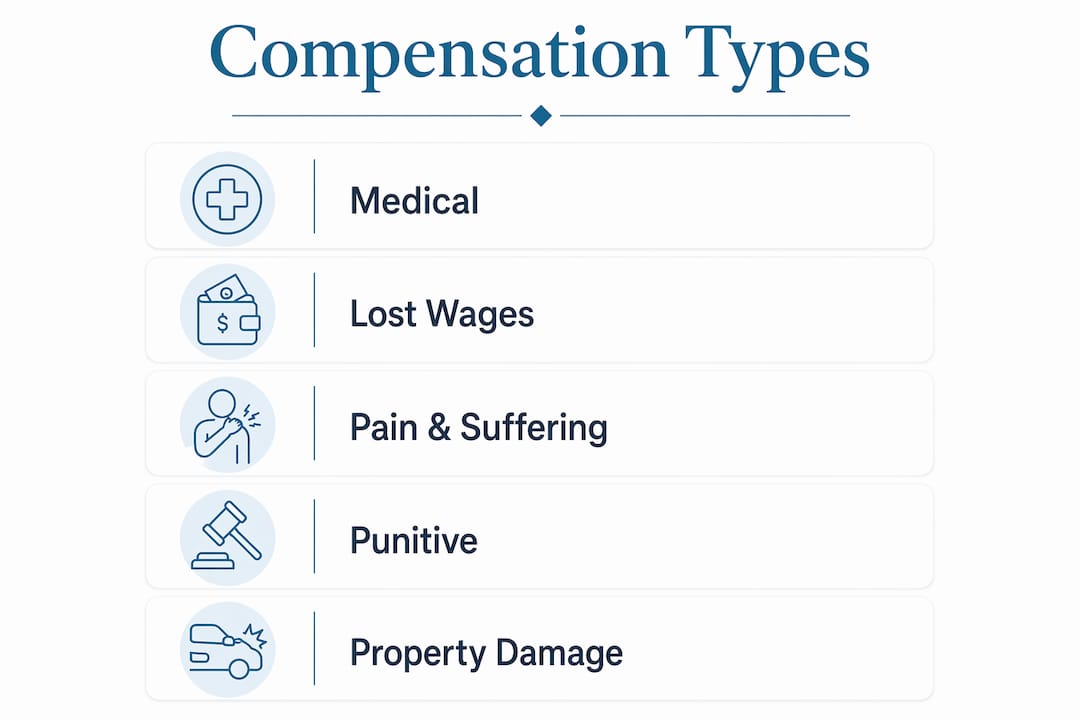
Punitive damages are awarded less frequently. Courts reserve them for situations where the defendant's conduct was grossly negligent or intentional, such as a company that falsified driver logs to hide hours-of-service violations. State rules on damage caps vary widely, so the specific state where the accident occurred directly affects the maximum recovery available to you. Consulting a resource like the damages victims can claim guide from Accidentsurvivalguide gives you a clearer picture of what applies in your situation.
Why evidence preservation determines the outcome of your claim
Evidence is the foundation of every successful commercial vehicle accident claim, and the window to secure it closes faster than most victims realize. Digital evidence like ELDs and telematics logs can be overwritten within days if no legal action is taken to preserve them. That data loss is not always accidental.
The most critical evidence categories in business vehicle cases include:
| Evidence type | Why it matters |
|---|---|
| Electronic logging device (ELD) data | Proves hours-of-service violations and driver fatigue |
| GPS and telematics records | Establishes vehicle speed, route, and braking patterns at impact |
| Dashcam footage | Provides direct visual proof of fault and road conditions |
| Driver qualification file | Reveals prior violations, training gaps, or disqualifying history |
| Vehicle maintenance records | Shows whether known defects were ignored before the crash |
Preservation of ELD and event data recorder evidence requires a formal legal preservation notice, sometimes called a spoliation letter, sent directly to the trucking company or employer. Without this notice, companies have no legal obligation to retain data beyond their standard retention schedules. An attorney can send this letter within hours of being retained, which is one of the strongest reasons to seek legal help immediately after the accident.
Physical evidence matters just as much. Skid marks, vehicle damage patterns, road debris, and witness statements all degrade or disappear quickly. Photographs taken at the scene by you or a first responder can prove critical months later when the defense disputes how the crash happened.
Pro Tip: If you are physically able at the scene, photograph the commercial vehicle's license plate, USDOT number on the door, and any visible cargo labels. These identifiers connect the vehicle to the carrier's federal safety record, which your attorney can subpoena.
Thorough documentation of the accident timeline is the single most effective defense against insurance company blame-shifting tactics. Carriers routinely argue that victims contributed to the crash or that injuries predated the accident. A complete, contemporaneous record makes those arguments far harder to sustain.
How comparative fault and filing deadlines affect your recovery
Comparative fault is the legal rule that reduces your compensation based on your percentage of responsibility for the accident. Every state uses some version of this system, but the rules differ in ways that can dramatically change your outcome.
Key distinctions to understand:
- Pure comparative negligence states, like Mississippi, allow you to recover damages even if you are 99% at fault, though your award is reduced by your fault percentage.
- Modified comparative fault states, like Florida, bar recovery entirely if your fault exceeds 50%. Florida's modified comparative fault rule means a victim found 51% responsible receives nothing, regardless of the severity of their injuries.
- Contributory negligence states, a small minority, bar recovery if the victim bears any fault at all.
Insurance adjusters understand these rules better than most victims do. They use recorded statements, social media posts, and accident scene photos to build a case that you share blame. Every percentage point of fault they assign to you reduces their payout. This is why comparative fault allocation is one of the most contested issues in commercial vehicle claims, and why you should never admit fault or speculate about the cause of the crash in any conversation with an insurer.
Filing deadlines are equally unforgiving. Florida personal injury claims carry a two-year statute of limitations starting from the accident date. Miss that deadline and the court will dismiss your case regardless of how strong your evidence is. Other states set different limits, ranging from one to six years, and special rules apply when a government vehicle is involved, often requiring notice within 30 to 180 days.
Filing an insurance claim does not pause the legal deadline to file a lawsuit. Many victims assume that ongoing settlement negotiations protect their rights. They do not. Consulting an attorney early, ideally within days of the accident, protects both your evidence and your right to sue if negotiations fail. You can explore your accident victim legal rights in detail through Accidentsurvivalguide's free resources.
Key takeaways
Business vehicle accident victims hold broader legal rights than standard car accident victims, with access to multiple liable parties, higher insurance limits, and federal regulatory protections that strengthen every claim.
| Point | Details |
|---|---|
| Multi-party liability | Employers, vehicle owners, and contractors can all share fault alongside the driver. |
| Higher insurance limits | FMCSA rules require commercial carriers to carry at least $750,000 in liability coverage. |
| Evidence preservation urgency | ELD and telematics data can be overwritten within days without a formal preservation notice. |
| Comparative fault rules vary | States like Florida bar recovery if victim fault exceeds 50%; know your state's rule before speaking to insurers. |
| Filing deadlines are absolute | Missing the statute of limitations ends your right to sue, regardless of evidence strength. |
What I've learned after years of watching victims navigate these cases
Scott here. After going through a serious accident myself and then spending years building Accidentsurvivalguide alongside Kathy, I have watched hundreds of victims make the same preventable mistakes in business vehicle cases. The biggest one is treating a commercial vehicle crash like a fender-bender with a private driver.
These cases are not the same. The company on the other side has a legal team, an insurance adjuster, and an accident response protocol that activates the moment the crash is reported. By the time you are still sitting in the emergency room, their people are already at the scene collecting evidence and building a narrative. That asymmetry is real, and it is the reason early legal intervention matters so much more in commercial cases than in personal vehicle accidents.
The second mistake I see constantly is victims talking too much, too soon. An insurance adjuster calling you two days after the crash is not there to help you. They are there to get a recorded statement that locks you into a version of events before you have seen the full evidence. Say as little as possible until you have spoken with an attorney.
The third mistake is underestimating the value of the claim. Truck accident compensation in commercial cases regularly reaches settlements that dwarf what victims initially expect, precisely because of the multi-party liability structure and the higher insurance limits involved. Do not accept a quick settlement offer before you understand the full scope of your injuries and your legal rights.
— Scott
How Accidentsurvivalguide helps you protect your rights
If you were hit by a company vehicle and are trying to figure out your next move, Accidentsurvivalguide was built for exactly this moment. The platform provides free, plain-language guidance on everything from documenting your injuries to understanding what insurers are not telling you.
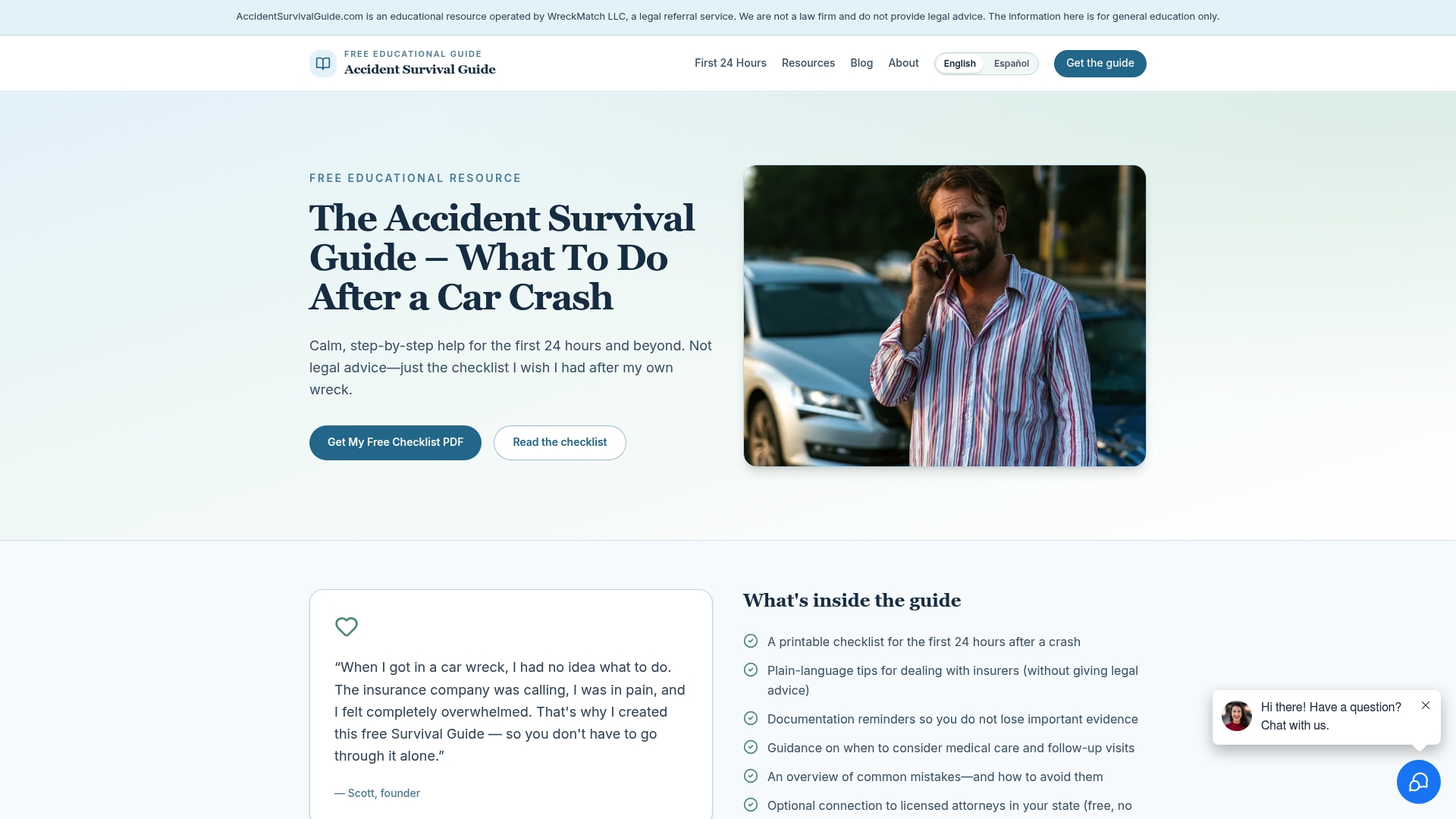
Start with the free compensation calculator to get a realistic estimate of what your claim may be worth based on your specific injuries and losses. Then explore the full library of resources at Accidentsurvivalguide.com covering employer liability, evidence preservation, and how to avoid the most common mistakes victims make in the first 72 hours after a commercial vehicle crash. You do not have to figure this out alone.
FAQ
What makes business vehicle accidents different from regular car accidents?
Business vehicle accidents involve potential liability from multiple parties, including the employer, vehicle owner, and maintenance contractors, not just the driver. Federal regulations like FMCSA insurance minimums also apply, raising the available coverage well above personal vehicle policy limits.
How long do I have to file a claim after a business vehicle accident?
Deadlines vary by state. Florida sets a two-year statute of limitations for personal injury claims from the accident date, while other states range from one to six years. Filing an insurance claim does not pause this deadline, so consult an attorney as soon as possible.
Can I still recover compensation if I was partly at fault?
In most states, yes. Pure comparative negligence states allow recovery even with significant fault, though your award is reduced by your percentage of responsibility. Modified comparative fault states like Florida bar recovery entirely if your fault exceeds 50%.
What evidence is most important in a commercial vehicle accident claim?
ELD data, GPS telematics records, dashcam footage, driver qualification files, and vehicle maintenance records are the most critical. A formal preservation notice must be sent to the company quickly, since electronic data can be overwritten within days.
Does the employer's insurance cover my injuries if their driver hit me?
Yes, in most cases. Vicarious liability holds employers responsible for employee negligence during work duties, and commercial fleet policies are required to cover those claims. Policy limits in commercial cases commonly reach hundreds of thousands to millions of dollars.