
UPS corporate liability is established under the legal doctrine of respondeat superior, which holds UPS directly responsible when one of its drivers causes an accident while performing work duties. Unlike gig-economy delivery contractors, UPS drivers are W-2 employees, a classification that removes any ambiguity about who bears legal responsibility. UPS also carries layered commercial insurance that starts at $1 million in primary coverage and extends through excess and umbrella policies. Beyond vicarious liability, you can pursue corporate negligence claims against UPS itself for failures in hiring, training, or vehicle maintenance. Understanding the UPS accident corporate liability process gives you a concrete legal foundation before you speak with any insurer.
How does the UPS accident corporate liability process work?
The process moves through five distinct phases, and the decisions you make in the first 48 hours shape every phase that follows.
Phase 1: Immediate actions at the scene. Call 911 and request a police report, even for accidents that appear minor. Photograph the UPS vehicle, its markings, the driver's uniform, any cargo, and all road conditions. Collect the driver's name, employee ID if visible, and the vehicle's license plate and DOT number. These details confirm the driver was operating as a UPS employee, not a personal errand.

Phase 2: Documenting scope of employment. GPS and electronic logs are the backbone of any UPS liability claim. Dispatch records, route assignments, and delivery manifests confirm the driver was on duty at the time of the crash. Without this documentation, UPS's legal team will argue the driver was on a personal detour, which shifts or eliminates corporate liability.
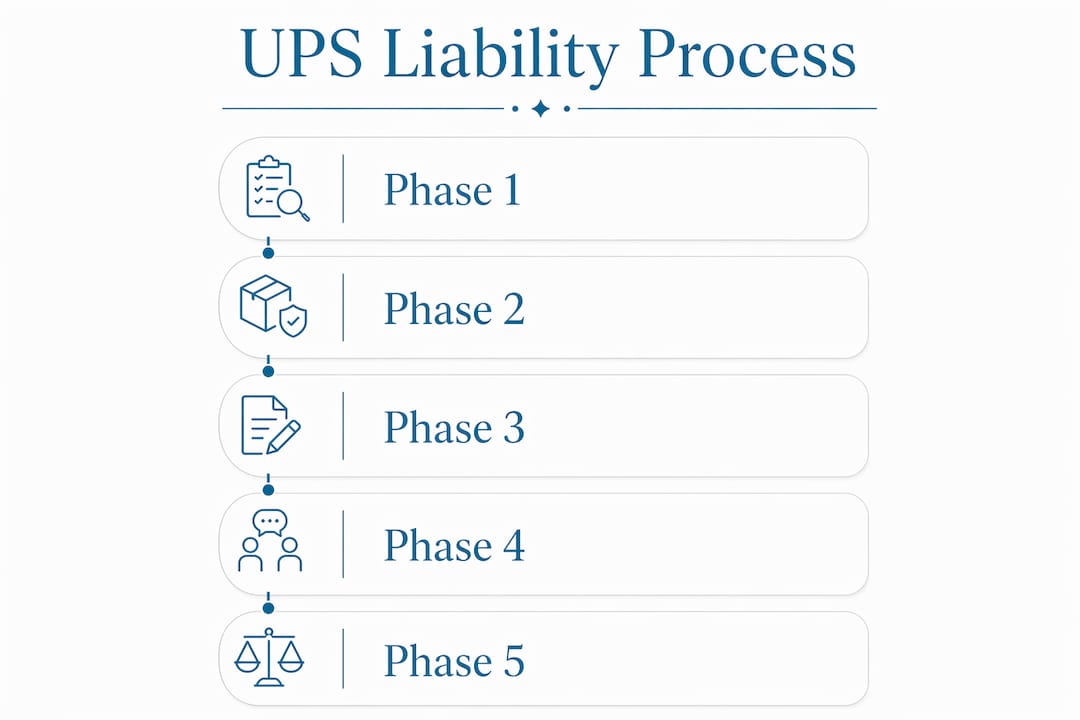
Phase 3: Filing the claim and sending preservation letters. Sending a spoliation letter within 24 to 48 hours of the accident is one of the most critical steps you can take. This letter formally demands that UPS preserve dashcam footage, telematics data, driver logs, and maintenance records. Courts can issue adverse jury instructions against UPS if it destroys evidence after receiving a preservation demand.
Phase 4: UPS's internal investigation. UPS deploys its own claims team almost immediately after a serious accident. That team's job is to minimize corporate exposure, which means they will look for evidence that the driver deviated from assigned duties or that your injuries are less severe than claimed. UPS's claims teams routinely attempt early settlements before your medical documentation is complete. Accepting any offer at this stage almost always undervalues your claim.
Phase 5: Legal representation and formal discovery. An attorney experienced in commercial vehicle accidents can subpoena UPS's internal safety records, training manuals, and driver history. This discovery phase is where corporate negligence claims gain traction and where settlement leverage grows substantially.
Pro Tip: Request the driver's complete employment file and safety training records through your attorney as early as possible. UPS has document retention policies that can legally destroy certain records after a set period, so timing matters.
What legal theories establish UPS's liability beyond driver negligence?
Respondeat superior covers the driver's negligence. Corporate negligence covers UPS's own failures, and the two theories work together to maximize your claim.
The core corporate negligence theories include:
- Negligent hiring: UPS failed to conduct adequate background checks and hired a driver with a prior history of traffic violations, DUI convictions, or disqualifying medical conditions.
- Negligent training: UPS set delivery quotas that pressured drivers to skip safety protocols, or provided insufficient instruction on defensive driving and load securing.
- Negligent retention: UPS kept a driver on active routes despite documented complaints, prior accidents, or failed drug tests.
- Negligent entrustment: UPS assigned a vehicle to a driver it knew, or should have known, was unfit to operate it safely.
Each of these theories targets UPS's internal failures rather than the driver's individual conduct. This distinction matters because it frames UPS as an organization with systemic safety problems, not just an employer unlucky enough to have one bad driver. Juries respond differently to systemic failure arguments, and so do UPS's settlement negotiators.
Federal Motor Carrier Safety Administration regulations add another layer. When UPS violates FMCSA Hours of Service rules, that violation establishes negligence per se in many jurisdictions, meaning you do not need to prove the breach of duty separately. The regulatory violation itself satisfies that element of your negligence claim.
Pro Tip: Ask your attorney to pull UPS's FMCSA safety rating and any out-of-service orders on the specific vehicle involved. A vehicle with deferred maintenance violations strengthens a negligent entrustment argument significantly.
Adding negligent hiring and training claims increases settlement potential by framing UPS as responsible for systemic safety failures rather than a single driver's error. This approach consistently produces higher valuations in pre-trial negotiations.
How do scope of employment and driver status affect UPS liability?
Scope of employment is the legal test courts use to decide whether UPS is responsible for its driver's actions at the moment of the crash. The analysis is fact-specific and turns on three factors: time, place, and purpose.
| Factor | On-Duty Indicators | Off-Duty Red Flags |
|---|---|---|
| Time | During scheduled shift hours | After clocking out or before shift start |
| Place | On assigned delivery route | Personal destination unrelated to deliveries |
| Purpose | Furthering UPS's delivery mission | Personal errand, commute, or recreational travel |
| Vehicle | UPS-owned or leased delivery truck | Personal vehicle |
| Uniform | UPS uniform and ID | Personal clothing |
Courts distinguish between a minor detour and a substantial departure from employment scope. A driver who stops briefly for coffee while on route is likely still within scope. A driver who drives 20 miles off route to visit a family member before returning to deliveries may have broken the chain of employer liability. Courts evaluate time, place, and purpose to determine whether vicarious liability applies, and the outcome of that analysis can determine whether UPS pays or whether you are left pursuing only the driver's personal assets.
Telematics data is decisive in these disputes. Modern UPS vehicles carry electronic logging devices that record speed, location, braking events, and idle time in real time. ELDs, GPS, and dispatch records are pivotal in civil scope-of-employment disputes, and losing access to this data through delayed evidence requests can stall or sink a claim. Disputes frequently arise over whether the accident happened during short breaks, backing maneuvers, or between stops. Documenting uniform use and vehicle timestamps at the scene is the most reliable way to demonstrate continuous scope of employment.
What insurance coverage and settlement dynamics apply in UPS accident claims?
UPS does not carry a single liability policy. It operates an insurance tower, a layered structure designed to handle catastrophic claims without exposing the company's core assets.
| Coverage Layer | Typical Function | Why It Matters to You |
|---|---|---|
| Primary commercial auto | First-dollar coverage, often $1 million | Covers most serious injury claims |
| Excess liability | Activates after primary is exhausted | Critical in catastrophic injury or fatality cases |
| Umbrella policy | Broadest coverage, highest limits | Rarely reached, but available in multi-victim crashes |
| Self-insured retention | UPS pays claims below a set threshold directly | Affects negotiation behavior and speed |
UPS carries primary coverage starting at $1 million, well above the federal minimum for commercial carriers. This matters because it means there is real money available for serious injuries. The challenge is that UPS's self-insured retention and layered claims organization affect how its negotiators behave. UPS has self-insured retention structures that make early comprehensive valuation documentation more critical than accepting initial settlement offers. When UPS pays claims below a certain threshold directly, its adjusters have a financial incentive to settle fast and low.
The practical implication is straightforward. Never accept a first offer before your medical treatment is complete and your long-term prognosis is documented. Use an accident compensation calculator to establish a baseline valuation before entering any negotiation. Knowing the full insurance tower also prevents you from settling for primary policy limits when excess coverage exists for your level of injury.
What practical steps protect your rights in the UPS liability process?
The steps below are ordered by urgency. Each one directly affects your ability to recover full compensation.
- Send a preservation letter within 48 hours. Address it to UPS's legal department and its insurer. Demand retention of dashcam footage, telematics data, driver logs, maintenance records, and training files. Failure to preserve can lead to adverse jury instructions that hurt UPS's defense.
- Seek medical attention immediately. Gaps in treatment are the single most common argument insurers use to reduce injury valuations. Document every symptom, even those that seem minor.
- Preserve your own evidence. Save all photos, witness contact information, police report numbers, and any communication from UPS or its insurer. Do not delete text messages or emails.
- Know your statute of limitations. Personal injury claims against corporations like UPS are subject to statutory time limits that vary by state, typically two years from the date of the accident. Missing this deadline eliminates your right to sue entirely.
- Hire an attorney before speaking with UPS's claims team. UPS's adjusters are trained negotiators. You are not required to give a recorded statement, and doing so without legal counsel frequently damages your claim.
Pro Tip: If you were injured by a UPS driver, request the driver's complete hours-of-service records for the 7 days before the accident. Fatigue-related violations in that window can establish a pattern of negligence that significantly increases your settlement leverage.
Understanding employer liability for commercial crashes is the foundation for every step above. The more clearly you document UPS's responsibility, the stronger your position in every phase of the claims process.
Key takeaways
The UPS accident corporate liability process requires proving driver scope of employment, asserting both vicarious and direct corporate negligence, and preserving electronic evidence within 48 hours to protect full claim value.
| Point | Details |
|---|---|
| Respondeat superior is the foundation | UPS is liable when its W-2 driver causes an accident while on duty and performing delivery work. |
| Corporate negligence expands your claim | Negligent hiring, training, and entrustment claims target UPS's systemic failures, not just one driver's error. |
| Scope of employment is decisive | GPS, ELD data, and dispatch records confirm on-duty status and determine whether UPS pays. |
| Insurance tower coverage is substantial | UPS carries primary coverage starting at $1 million, with excess and umbrella layers above that. |
| Early evidence preservation is non-negotiable | A spoliation letter within 48 hours protects dashcam footage and telematics data before UPS can destroy them. |
What I've learned from watching UPS liability cases up close
After years of working with accident victims and studying how corporate claims processes actually unfold, one pattern stands out clearly. Most people underestimate how quickly UPS's claims organization moves after a serious accident. They have experienced adjusters, legal teams, and investigators on the ground fast. The average injured person is still in the emergency room when UPS's team has already begun building its defense.
The corporate negligence angle is consistently underused. Victims focus on the driver's error, which is understandable. But asserting that UPS created the conditions for that error, through unrealistic delivery quotas, inadequate training, or ignored maintenance flags, changes the entire negotiation dynamic. It shifts the conversation from "one driver made a mistake" to "UPS has a systemic safety problem," and that framing produces meaningfully different settlement outcomes.
My strongest advice is this: treat the first 48 hours after a UPS accident as your most important window. Get the preservation letter out. Get to a doctor. Get an attorney on the phone. Everything that happens after that is easier when those three steps are done. Persistence and preparation are not optional in these cases. They are the difference between a fair recovery and a lowball settlement you regret accepting.
— Scott
Get the support you need after a UPS accident
Dealing with a corporate giant like UPS after an accident is genuinely difficult. Accidentsurvivalguide was built specifically for moments like this. The platform offers free educational resources covering commercial vehicle accident damages, insurance tactics, evidence preservation, and legal rights. You can also access a free compensation calculator to estimate your claim's value before any negotiation begins. Whether you are trying to understand your rights or figure out your next move, Accidentsurvivalguide gives you the tools to make informed decisions and connect with experienced legal professionals who handle UPS accident claims nationwide.
FAQ
Is UPS always liable when its driver causes an accident?
UPS is liable when its driver was acting within the scope of employment at the time of the accident. If the driver was on a personal errand or had substantially departed from assigned duties, UPS may argue it bears no responsibility.
How do I file a UPS accident claim?
Start by sending a written preservation demand to UPS and its insurer within 48 hours, then file a formal claim through UPS's liability insurer. An attorney experienced in commercial vehicle accidents can handle the filing and protect your claim from early lowball offers.
What evidence is most important in a UPS accident liability case?
GPS and telematics data, electronic logging device records, dispatch logs, dashcam footage, and the driver's employment and training history are the most critical evidence types. Securing these quickly through a spoliation letter prevents UPS from destroying them.
Can I sue UPS directly, or only the driver?
You can sue both. Respondeat superior makes UPS vicariously liable for the driver's negligence, while corporate negligence theories let you sue UPS directly for failures in hiring, training, and vehicle maintenance.
How long do I have to file a claim against UPS?
The statute of limitations for personal injury claims varies by state, but most states set a two-year deadline from the date of the accident. Missing this deadline permanently bars your claim, so consult an attorney as soon as possible.