
The accident medical treatment timeline is defined as the sequence of medical evaluations, treatments, and recovery milestones that begin within hours of an injury and continue until a patient reaches Maximum Medical Improvement (MMI). Getting this timeline right matters for two reasons: your physical recovery and your legal claim. Insurance adjusters scrutinize every gap in your care. Knowing the exact steps, from your first ER visit to your final physical therapy session, puts you in control of both outcomes. Accidentsurvivalguide was built specifically to help you understand this process before you make a costly mistake.
What are the critical timeframes for the accident medical treatment timeline?
Seeking initial evaluation within 24–72 hours is the single most important step in the entire accident recovery process. That visit creates a timestamped medical record that links your injuries directly to the accident. Without it, insurance adjusters can argue your injuries happened elsewhere or were pre-existing.
The 72-hour window is not just a medical recommendation. It is a legal protection. Insurers use what practitioners call the "72-hour rule" to scrutinize your claim from day one. A gap beyond 72 hours before your first evaluation gives them grounds to discount or deny your claim entirely.
Follow-up care carries its own timing rule. A gap of more than 10 days between physical therapy sessions or follow-up appointments is a red flag for insurance adjusters. They interpret that gap as evidence that your injuries were not serious enough to require consistent care. Consistent treatment is both medically sound and legally protective.
Choosing the right facility for your first visit matters more than most people realize. Emergency rooms are best for suspected fractures, head trauma, or internal injuries. Urgent care centers handle soft tissue injuries and minor lacerations well. Primary care physicians are appropriate for follow-up management but are rarely equipped to establish a full injury baseline on day one. The right choice depends on your symptoms, not convenience.
Key timeframes to track from day one:
- 0–72 hours: Initial medical evaluation at an ER or urgent care facility
- 3–7 days: Follow-up with a primary care physician or specialist
- 7–14 days: Begin physical therapy if recommended
- Every 7–10 days: Ongoing treatment appointments to avoid claim-damaging gaps
- Ongoing: Document every visit, prescription, and symptom change
Pro Tip: Prioritize facilities that offer on-site imaging such as X-ray and MRI. A diagnosis backed by imaging is far harder for an insurer to dispute than a clinical observation alone.
How does the recovery process typically progress over weeks and months?

The post-accident recovery process follows three biological phases: inflammation, repair, and remodeling. Understanding these phases helps you set realistic expectations and recognize when your recovery is on track.
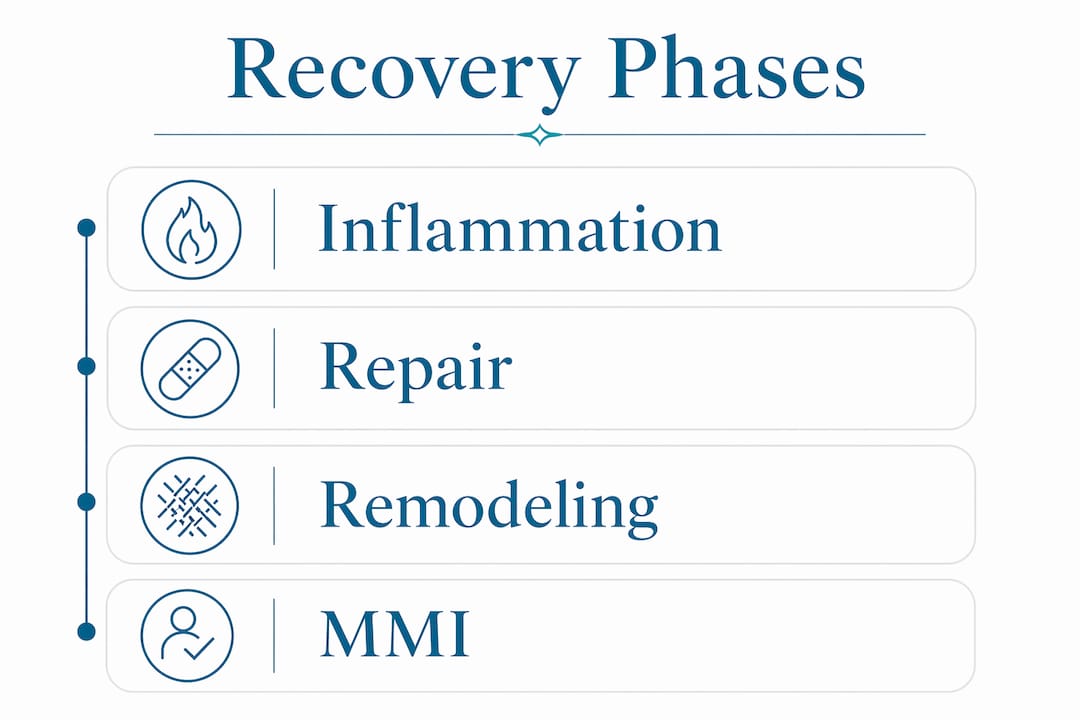
The inflammation phase runs from day one through roughly day five. Pain, swelling, and limited range of motion are normal during this window. Rest and pain management are appropriate here, but rest alone is insufficient for full recovery. Early guided movement, when cleared by your physician, prevents scar tissue from forming in ways that limit long-term function.
The repair phase spans roughly weeks two through six. This is when physical therapy becomes the primary treatment tool. Therapists use criteria-based milestones, including range of motion measurements and strength tests, rather than calendar dates alone. Treatment progress should be criteria-based, not just time-based, because healing is rarely linear. Two patients with the same diagnosis can have very different recovery curves.
The remodeling phase begins around week six and can last months or years for serious injuries. This is where strengthening and conditioning work happens. Patients who complete the strengthening phase after reaching MMI significantly reduce their risk of reinjury and chronic pain. Skipping this phase is one of the most common reasons people experience recurring problems years after an accident.
Maximum Medical Improvement (MMI) is the point at which your condition has stabilized and further significant improvement is unlikely. MMI does not mean you are fully healed. It means your condition has plateaued. MMI timing varies widely by injury type and severity.
| Injury type | Severity | Typical recovery timeline |
|---|---|---|
| Soft tissue (whiplash, sprains) | Minor | 6–12 weeks |
| Soft tissue with physical therapy | Moderate | 3–6 months |
| Fractures or torn ligaments | Serious | 6–12 months |
| Surgical injuries (spinal, joint) | Severe | 9–18 months |
| Catastrophic (TBI, spinal cord) | Critical | Up to 3 years or longer |
Recovery timelines by injury type reflect published estimates from medical and legal recovery guides. Your actual timeline depends on age, pre-existing conditions, and how consistently you follow your treatment plan.
What documentation practices support your recovery and legal claim?
Thorough documentation is the backbone of both a successful recovery and a strong insurance claim. Daily or bi-weekly medical treatment logs that track symptoms, medications, and functional limitations are the most effective way to establish your condition over time. These logs also help your physician determine when you have reached MMI, which directly affects your settlement value.
The documents you need to retain fall into several categories. Medical charts and physician notes capture your diagnosis and treatment plan. Imaging reports, including X-rays and MRIs, provide objective evidence of injury. Prescriptions and pharmacy receipts document your medical expenses timeline. Discharge papers from the ER or urgent care establish the date and nature of your initial evaluation.
Documents to collect and organize from day one:
- Emergency room or urgent care discharge papers
- Physician notes from every follow-up visit
- Physical therapy progress notes and milestone assessments
- Imaging reports (X-ray, MRI, CT scan)
- Prescription records and pharmacy receipts
- Out-of-pocket expense receipts (co-pays, medical equipment, transportation)
- A personal symptom journal with dated entries
The Accidentsurvivalguide car accident documentation checklist covers every record type you need to gather for a complete legal file. Keeping these records organized from day one prevents scrambling later when an adjuster requests proof.
Pro Tip: Use a free app like Google Keep or a simple dated notebook to log your symptoms every morning. Note your pain level on a 1–10 scale, any new symptoms, and how your limitations affected daily activities. This log becomes powerful evidence.
What common mistakes do accident victims make during the treatment timeline?
The biggest mistake accident victims make is waiting to see if they feel better before seeking care. Early intervention including guided therapy is critical for effective recovery. The "wait and see" approach costs victims both physically and legally.
Missing follow-up appointments is the second most damaging mistake. A single missed physical therapy session rarely causes problems. A pattern of missed appointments or a 10-day gap in treatment tells the insurer your injuries were not serious. Reschedule within 48 hours if you must cancel.
Accepting a vague diagnosis without pushing for imaging is a mistake that directly affects claim value. Insurance adjusters look for vague diagnoses like "sprain" or "strain" and use them to minimize settlements. If your wrist pain persists after two weeks, ask your physician specifically about an MRI to rule out a TFCC tear. Specific diagnoses backed by imaging produce stronger claims and better care plans.
Neglecting to track emerging symptoms is another common error. Symptoms like headaches, cognitive fog, or radiating pain that appear days after an accident are still accident-related. Document them immediately and report them to your physician at your next visit. Delayed symptom onset is medically normal, especially for soft tissue and neurological injuries.
When an insurer denies coverage for a recommended treatment, a verbal appeal rarely works. A letter of medical necessity from your physician, written in clinical terms, is far more effective than a phone call. Ask your doctor to write one the same day a denial arrives.
Top mistakes and how to avoid them:
- Delaying initial evaluation: Seek care within 72 hours, no exceptions
- Skipping follow-ups: Keep every appointment or reschedule within 48 hours
- Accepting vague diagnoses: Request imaging when symptoms persist beyond two weeks
- Ignoring new symptoms: Report and document any symptom that appears after the accident
- Failing to document: Log every visit, expense, and symptom from day one
- Not getting legal advice early: Read why early legal consultation can protect your claim before you speak with an adjuster
Key takeaways
The accident medical treatment timeline requires prompt evaluation within 72 hours, consistent follow-up care, criteria-based recovery milestones, and thorough documentation to protect both your health and your legal claim.
| Point | Details |
|---|---|
| 72-hour evaluation rule | Seek initial medical care within 72 hours to create a timestamped injury record. |
| Avoid treatment gaps | Keep follow-up appointments within 10 days to prevent insurance claim disputes. |
| Recovery is criteria-based | Measure progress by range of motion and strength, not just weeks elapsed. |
| Document everything | Retain all medical records, imaging, prescriptions, and a personal symptom log. |
| Request imaging proactively | Specific diagnoses backed by MRI or X-ray produce stronger claims and better care. |
What I've learned watching accident victims navigate this process
I have seen the same pattern repeat itself more times than I can count. Someone gets rear-ended on a Tuesday, feels sore but functional, and decides to rest over the weekend before calling a doctor. By the time they walk into an urgent care on Monday, six days have passed. The insurer's adjuster notes the gap immediately and uses it to argue the injuries were minor or unrelated.
The medical system does not automatically protect you. Physicians are focused on treatment, not on building your legal case. That gap between medical care and legal documentation is where most accident victims lose ground. You have to be the one who connects those dots, or find someone who will help you do it.
The other thing I have seen consistently is that people underestimate how long recovery actually takes. They reach a point where they feel "mostly okay" and stop physical therapy. Then six months later, the chronic pain returns. Completing the full strengthening phase after MMI is not optional if you want a durable recovery. It feels like extra work when you are tired of being a patient. Do it anyway.
My honest advice: treat your medical file the same way you would treat a financial record during an audit. Every receipt, every note, every appointment matters. The accident happened to you. The documentation work is how you make sure the system responds to what actually happened.
— Scott
Free tools to support your treatment timeline and claim
Accidentsurvivalguide offers free resources built specifically for accident victims who are managing their medical treatment and insurance claims at the same time.

The free accident compensation calculator lets you input your injury type, treatment duration, and expenses to get an estimate of potential compensation. It takes less than five minutes and gives you a concrete starting point before you speak with an adjuster or attorney. Pair it with the medical documentation guide to make sure your records are complete before any settlement conversation begins. Both tools are free, no sign-up required.
FAQ
How soon should I see a doctor after an accident?
See a doctor within 24–72 hours of the accident. This creates a timestamped medical record that links your injuries to the incident and protects your insurance claim.
What happens if I wait more than 72 hours to seek care?
Insurance adjusters use delays beyond 72 hours to argue that your injuries were not caused by the accident or were not serious. This can result in a reduced settlement or a denied claim.
How long does accident recovery typically take?
Recovery time depends on injury severity. Soft tissue injuries heal in 6–12 weeks, moderate injuries with physical therapy take 3–6 months, and surgical injuries can take 9–18 months or longer.
What is Maximum Medical Improvement (MMI)?
MMI is the point at which your condition has stabilized and significant further improvement is unlikely. It does not mean full recovery. MMI timing is used to calculate final settlement values.
What should I do if my insurance denies a recommended treatment?
Ask your physician to write a letter of medical necessity using clinical terms. Formal written requests from physicians are more effective than verbal appeals and are harder for insurers to dismiss.