
Truck accident hospital bills coverage is defined as the combination of your own health insurance, Personal Injury Protection (PIP), and Medical Payments (MedPay) coverage that pays your medical costs while a liability claim against the trucking company is still pending. The trucking company's insurer does not pay your bills as they arrive. It pays a lump-sum settlement only after liability is fully established, which can take months or years. That gap is where most victims get into financial trouble. Understanding who pays first, and how to protect yourself in the meantime, is the most important financial decision you will make after a truck collision.
What insurance coverages pay truck accident hospital bills?
Three primary coverage types handle your immediate medical expenses after a truck accident: private health insurance, PIP, and MedPay. Each works differently, and knowing which applies to you determines how fast your bills get paid.

Private health insurance
Your personal health insurance is the first line of defense for truck accident medical expenses. Carriers like UnitedHealthcare, Aetna, and Blue Cross Blue Shield have pre-negotiated rates with hospitals and physicians, which means the amount they actually pay is far less than the original bill. A $100,000 hospital invoice may be settled for $30,000 after the insurer's contracted rate applies. That gap matters when you later pursue a personal injury claim, because the collateral source rule in most states allows you to sue for the full billed amount even when insurance paid less.
Personal injury protection (PIP)
PIP is mandatory in no-fault states like Florida, Michigan, and New York. It covers roughly 80% of necessary medical bills up to your policy cap, regardless of who caused the accident. PIP also covers a portion of lost wages, which makes it more valuable than most people realize. One critical warning: failing to seek timely medical care after your accident can result in your PIP benefits being denied entirely.
Medical payments coverage (MedPay)
MedPay is a supplemental, fault-independent coverage available in most states. It typically ranges from $1,000 to $10,000 and pays medical bills for you and your passengers no matter who caused the crash. MedPay does not replace health insurance or PIP. It fills the gaps, covering deductibles, copays, and expenses your primary insurance leaves behind.
| Coverage Type | Fault Required? | Typical Limit | What It Covers |
|---|---|---|---|
| Health Insurance | No | Varies by plan | Hospital, physician, lab bills |
| PIP | No | Varies by state | 80% of medical bills, lost wages |
| MedPay | No | $1,000–$10,000 | Medical bills, copays, deductibles |
| Trucking Co. Liability | Yes (proven) | Policy limits | Final settlement after case closes |
Pro Tip: File with your health insurance immediately after the accident, even if you plan to pursue a personal injury claim. Waiting for the trucking company's insurer to pay guarantees your bills go to collections.
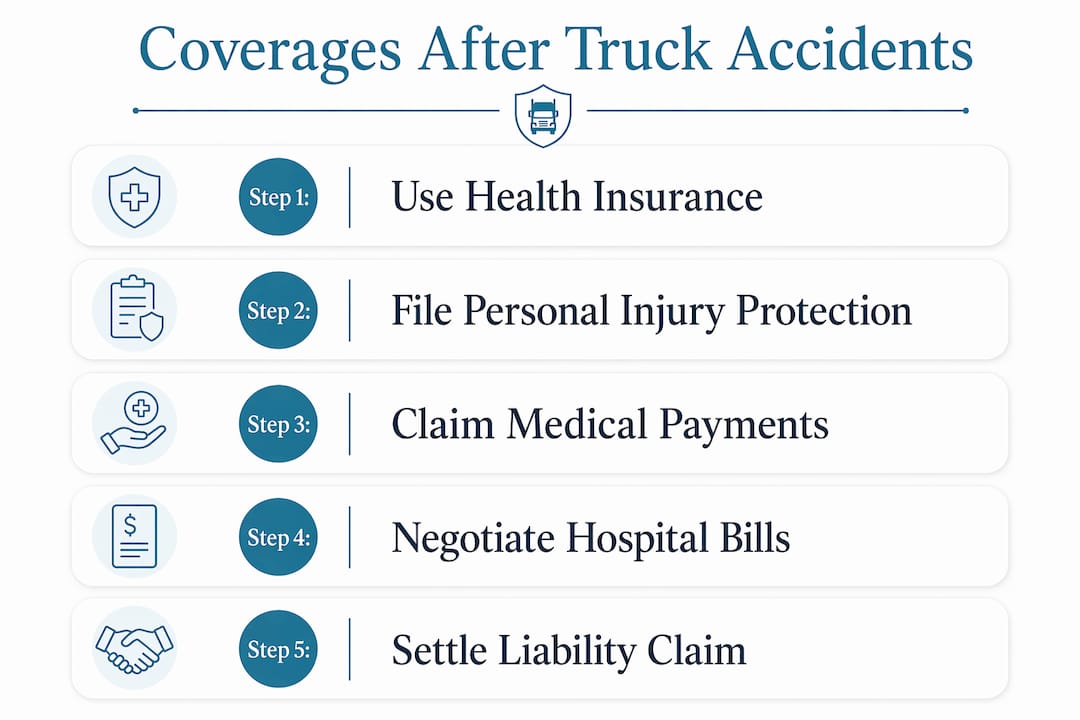
How to manage hospital bills while awaiting a settlement
The period between your accident and a final settlement is where financial damage happens if you are not proactive. Truck accident claims regularly take 12–24 months to resolve. Your hospital bills will not wait that long.
Here is a step-by-step approach to protect yourself during that window.
-
File with your health insurance on day one. Do not wait for a liability determination. Your health insurer pays immediately, protects your credit, and prevents collections from starting.
-
Contact the hospital billing department early. Hospitals are far more willing to set up payment plans or pause collections when you reach out before an account goes delinquent. Proactive communication with hospital billing reduces credit damage risk and lowers your stress significantly.
-
Ask your attorney about a Letter of Protection (LOP). A Letter of Protection is a legally binding contract between your attorney and your medical provider. It pauses billing and collection activity and guarantees payment from your settlement. This tool allows you to continue receiving treatment without paying out of pocket and without damaging your credit score.
-
Track every out-of-pocket expense. Out-of-pocket costs include deductibles, copays, travel to appointments, prescription costs, and home modifications for mobility. Every dollar you document becomes part of your personal injury claim.
-
Avoid high-interest credit cards. Charging medical bills to a credit card at 20%+ interest creates a debt spiral that your settlement may not fully cover. Instead, explore zero-interest payment plans directly with providers or use your MedPay coverage to cover gaps.
Pro Tip: Hospitals aggressively pursue collections unless legal steps like Letters of Protection are in place. If you have an attorney, ask about an LOP at your very first appointment with any new provider.
What do hospital bills actually cost after a truck crash?
Truck accidents produce some of the most severe injuries on the road, and the bills reflect that reality. Knowing the cost ranges in advance helps you understand why coverage gaps are so dangerous.
Emergency room visits after a truck collision typically cost $1,500 to $10,000. That range covers evaluation, imaging, and stabilization. If you are admitted, the average inpatient stay costs around $57,000. Air ambulance transport alone runs approximately $50,000, and severe injuries can push total hospital costs well past $100,000.
What makes truck accident billing especially confusing is the layered structure. You will not receive one bill. You will receive separate invoices from the hospital facility, the attending physician, the radiologist, the anesthesiologist, the lab, and the ambulance service. Each of those providers may be in or out of your insurance network, which changes what you owe.
| Service | Typical Cost Range |
|---|---|
| Emergency Room Visit | $1,500–$10,000 |
| Inpatient Hospital Stay | ~$57,000 average |
| Air Ambulance Transport | ~$50,000 |
| Specialty Surgery | $20,000–$150,000+ |
| Physical Therapy (course) | $3,000–$15,000 |
Your insurer negotiates these amounts down through contracted rates. The difference between the billed amount and the negotiated rate is called the "write-off." Understanding this distinction matters because your personal injury claim can reference the full billed amount in many states, not just what insurance paid. For a deeper look at what damages you can claim, the commercial vehicle accident guide at Accidentsurvivalguide breaks this down clearly.
How settlements and subrogation affect your final payout
Once the trucking company's insurer agrees to a settlement, the money does not go directly to you in full. Several parties have legal claims on those funds before you receive a dollar.
Here is how the settlement allocation typically works:
- Attorney fees are deducted first, usually 33%–40% of the gross settlement.
- Medical liens from hospitals must be paid. Hospitals in many states can file statutory liens that attach directly to your settlement proceeds.
- Health insurer subrogation liens require your carrier to be reimbursed for what it paid on your behalf. Medicare and Medicaid have federal subrogation rights that take priority over nearly everything else.
- Remaining balance goes to you as net compensation.
Health insurers and Medicare place subrogation liens on settlements to recover what they paid, which directly reduces your take-home amount. This is not optional. It is a legal obligation. The good news is that an experienced personal injury attorney can often negotiate these liens down, increasing what you actually receive.
Full documentation of every medical expense is the single most important thing you can do to protect your net recovery. Every bill, every receipt, every mileage log to a doctor's appointment adds to your documented damages. Gaps in documentation give insurers grounds to dispute or reduce your claim. The 2026 truck accident compensation guide at Accidentsurvivalguide covers exactly what to track and how to submit it.
An attorney who handles truck accident cases regularly knows how to negotiate with hospitals, health insurers, and Medicare to reduce lien amounts. That negotiation can mean the difference between walking away with meaningful compensation and barely breaking even after bills are paid.
Key takeaways
Truck accident hospital bills coverage requires your own insurance to pay first, with the trucking company's liability coverage settling only after the case closes and liens are resolved.
| Point | Details |
|---|---|
| Your insurance pays first | Health insurance, PIP, and MedPay cover bills while the liability claim is pending. |
| Letters of Protection pause collections | An LOP is a legal tool that stops billing and guarantees payment from your settlement. |
| Bills arrive in layers | Expect separate invoices from the hospital, physicians, labs, and ambulance services. |
| Subrogation reduces your payout | Health insurers and Medicare recover paid amounts from your settlement before you receive funds. |
| Document every expense | Complete records of all medical costs protect your claim and maximize your net recovery. |
What i've learned watching victims navigate this process
Most people who come to Accidentsurvivalguide after a truck accident share one common misconception: they believe the trucking company's insurer will step in and pay their bills right away. That belief is one of the most expensive mistakes a victim can make.
I have seen people wait weeks for a call from the trucking company's adjuster while their hospital bills pile up and collection notices start arriving. By the time they realize no one is coming to pay those bills, the damage to their credit and their stress levels is already done.
The financial reality of truck accident claims is that you are essentially fronting the cost of your own recovery. Your health insurance, PIP, and MedPay are the tools that protect you during that period. If you do not have those coverages, a Letter of Protection through an attorney is often the only way to keep receiving care without paying out of pocket.
The other thing I want you to understand is that the settlement process is not the end of the financial story. Subrogation liens from your health insurer, Medicare, or Medicaid will reduce what you take home. An attorney who negotiates those liens aggressively is not a luxury. That negotiation is often where the real money is recovered.
Stay organized. Keep every bill, every explanation of benefits, every receipt. The victims who come out of this process in the best financial shape are not the ones with the biggest settlements. They are the ones who documented everything and had a team working to reduce what they owed.
— Scott
How Accidentsurvivalguide helps you manage medical bills
Dealing with truck accident medical expenses is overwhelming when you are also trying to recover physically. Accidentsurvivalguide was built specifically to help you understand your options before you make a costly mistake.

At Accidentsurvivalguide, you get free access to plain-language guides on insurance coverage, billing management, and claim documentation. Use the accident compensation calculator to estimate your potential settlement and identify coverage gaps before you accept any offer. The platform also connects you with experienced legal professionals who handle truck accident cases nationwide. Start with the full accident resource center to get organized, informed, and protected from day one.
FAQ
Who pays my hospital bills right after a truck accident?
You are responsible for your own medical bills while the liability claim is pending. Your health insurance, PIP, or MedPay coverage pays first, not the trucking company's insurer.
What is a letter of protection and how does it help?
A Letter of Protection is a legally binding agreement between your attorney and a medical provider that pauses billing and guarantees payment from your future settlement. It protects your credit and allows you to continue treatment without upfront costs.
How much do emergency room visits cost after a truck accident?
Emergency room visits typically cost $1,500–$10,000, while inpatient stays average around $57,000. Air ambulance transport adds approximately $50,000, and severe injuries can push total costs well above $100,000.
What is subrogation and will it reduce my settlement?
Subrogation is the legal right of your health insurer or Medicare to recover what they paid from your settlement funds. It reduces your net payout, but an attorney can often negotiate these liens down to increase what you receive.
Should i use MedPay even if i have health insurance?
Yes. MedPay covers deductibles, copays, and expenses your health insurance does not pay. Using both together minimizes your out-of-pocket costs during the claims process.