
A truck accident wrongful death claim is a civil lawsuit filed by surviving family members to seek financial compensation when a fatal crash results from negligence by a truck driver, trucking company, or related parties. Unlike criminal cases, this legal action does not require a conviction. It requires proof that someone's careless or reckless conduct caused the death. These claims are among the most legally complex personal injury cases in the United States because they routinely involve multiple corporate defendants, federal regulations, and substantial insurance policies. Understanding the process from eligibility to evidence to compensation gives grieving families the clearest possible path forward.
Who can file a truck accident wrongful death claim?
Primary beneficiaries such as spouses, children, and parents are legally permitted to file wrongful death claims, with state laws defining specific priority orders. This matters because even a sibling or grandparent who was financially dependent on the deceased may have no legal standing to file independently. The law draws a hard line.
Most states follow a tiered priority system:
- Surviving spouse holds first priority in nearly every state
- Children of the deceased, including adult children, typically share standing with or follow the spouse
- Parents may file when no spouse or children survive
- Siblings or other relatives generally lack standing unless state law specifically grants it
- The estate's personal representative can file on behalf of beneficiaries when no immediate family member acts
Some states apply intestate succession rules to determine who qualifies, meaning the same order used to distribute assets without a will also governs who can bring a wrongful death claim. If you are unsure whether you qualify, that question alone is worth a consultation with a wrongful death attorney. Filing by the wrong party can result in dismissal.
Pro Tip: If multiple eligible family members exist, they typically share in the recovery through a single lawsuit rather than filing separate claims. Coordinating early avoids procedural conflicts.
How is liability established beyond the truck driver?
Liability in truck accident fatalities extends well beyond the driver to trucking companies, maintenance providers, cargo loaders, and vehicle manufacturers. This is the single most important structural difference between a truck accident wrongful death case and a standard car accident claim. A single crash can produce four or five liable defendants, each with separate insurance coverage.
Common driver-level causes of fatal crashes include:
- Hours of service violations caused by pressure to meet delivery deadlines
- Distracted driving from mobile devices or in-cab technology
- Impaired driving due to alcohol, prescription drugs, or stimulants
- Speeding or aggressive driving on highways and in adverse weather
Federal Motor Carrier Safety Administration (FMCSA) regulations, specifically 49 CFR § 395, mandate Electronic Logging Devices (ELDs) and cap driving hours. A violation of these rules is not just a regulatory infraction. It is direct evidence of negligence in a civil lawsuit. Attorneys use ELD records and black box data to reconstruct exactly what the driver was doing in the hours before impact.
Motor carriers can also be held liable under the doctrine of non-delegable duty, which means a trucking company cannot escape responsibility simply by classifying a driver as an independent contractor. Cargo brokers and freight shippers face liability when improper loading or overloading contributed to the crash. For a deeper look at employer liability in commercial crashes, the legal exposure of these corporate parties is substantial.

Pro Tip: Ask your attorney to identify every entity listed on the truck's registration, insurance certificate, and operating authority documents. Each one is a potential defendant.
What damages can families recover in a wrongful death case?
Economic damages in wrongful death claims include medical expenses incurred before death, lost earnings, household services, and funeral costs. These are calculated with precision, often with the help of forensic economists who project lifetime income, benefits, and the dollar value of services the deceased provided to the household. The numbers are frequently larger than families expect.
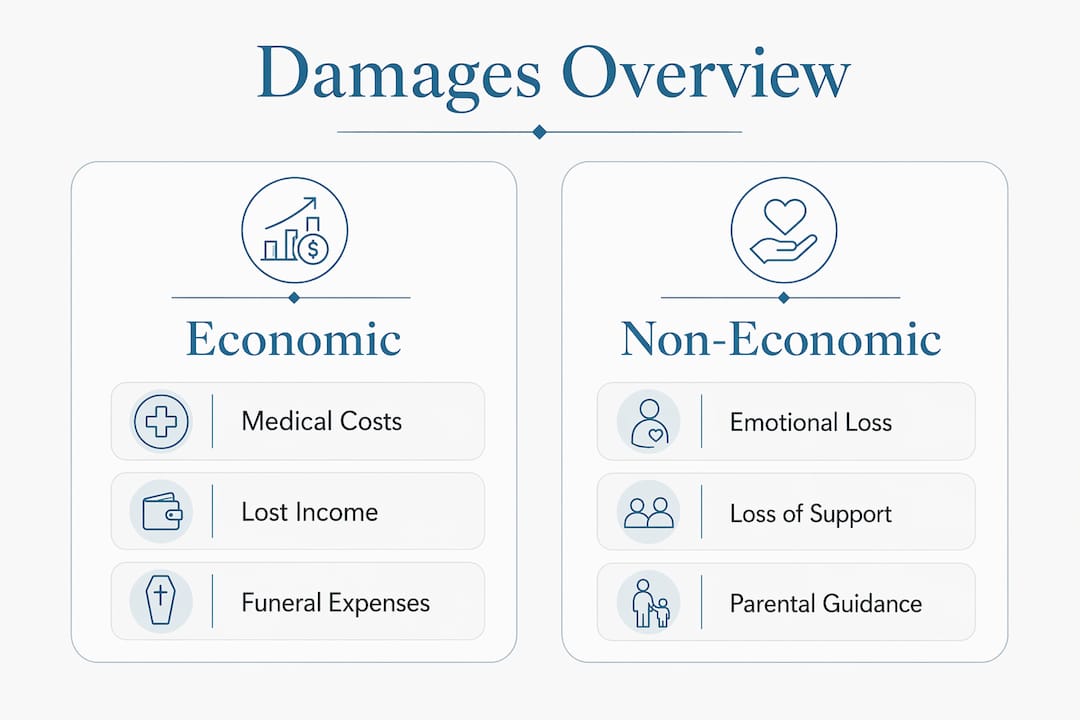
Non-economic damages address loss of companionship, parental guidance, consortium, and emotional support experienced by surviving family members. These losses are harder to quantify but often represent the largest component of total compensation. A child who loses a parent at age seven faces decades of lost guidance. Courts and juries recognize that.
A survival action is a separate claim representing the deceased's pain and suffering endured between the accident and death, recoverable by the estate. It is filed alongside the wrongful death claim, not instead of it. Separating these two claims allows families to maximize total recovery by capturing both the family's losses and the victim's own suffering.
| Damage type | What it covers |
|---|---|
| Economic damages | Lost income, medical bills before death, funeral costs, household services |
| Non-economic damages | Loss of companionship, parental guidance, emotional support, consortium |
| Survival action | Victim's conscious pain and suffering between crash and death |
| Punitive damages | Awarded when conduct was grossly negligent or willful, meant to punish |
Punitive damages apply when a trucking company's conduct rises to the level of gross negligence or willful misconduct. Examples include knowingly allowing a driver with a suspended license to operate, or falsifying maintenance records. These awards are not guaranteed, but they are pursued in cases where corporate conduct was egregious.
Pro Tip: Retain a forensic economist early. Their projections of lost lifetime earnings and household contributions often double the initial settlement offers made by trucking company insurers.
For a full breakdown of recoverable damages in commercial vehicle cases, the categories above are the starting framework, not the ceiling.
How to preserve evidence before it disappears
Evidence in truck accident cases disappears fast. ELD and black box data is often overwritten within 8 to 14 days of a crash, making preservation letters critical to prevent data loss. That window is shorter than most families realize when they are still in the immediate shock of losing someone.
Follow these steps to protect the evidence that wins cases:
- Retain an attorney immediately. The attorney's first action should be issuing a spoliation letter to the trucking company, its insurer, and any third-party maintenance or logistics firms.
- Demand preservation of the Electronic Control Module (black box). This device records speed, braking, throttle position, and seatbelt status in the seconds before impact.
- Secure ELD records. These logs document every hour the driver was on duty, off duty, or in the sleeper berth for the preceding 30 days.
- Request driver qualification files. These include the driver's license history, drug and alcohol test results, and prior accident records.
- Obtain maintenance and inspection logs. Brake failures and tire blowouts often trace back to skipped inspections documented in these records.
- Gather third-party evidence. Traffic cameras, toll records, GPS data from fleet management systems, and witness statements all support reconstruction of the crash.
Truck companies deploy rapid response teams to crash scenes to gather evidence and build defenses, which means the clock starts the moment the crash occurs. Families who wait weeks to consult an attorney often find that critical electronic data is already gone. Do not give any statements to the trucking company's investigators or insurers before speaking with your own counsel.
Pro Tip: A spoliation letter carries legal weight. Once received, the trucking company is legally obligated to preserve all listed evidence. Destruction after receipt can result in sanctions and adverse jury instructions.
What are the steps and deadlines for filing a claim?
Statutes of limitations for wrongful death claims vary by state but commonly run two years from the date of death, with exceptions as short as six months when a government entity owns or operates the truck. Missing this deadline eliminates the right to recover, regardless of how strong the case is.
The procedural path typically follows this sequence:
- Immediate steps: Retain specialized legal counsel, issue spoliation letters, and begin evidence collection within days of the crash
- Investigation phase: Attorneys reconstruct the crash, identify all liable parties, and retain expert witnesses including accident reconstructionists and forensic economists
- Demand and negotiation: A formal demand letter is sent to all defendants and their insurers, initiating settlement negotiations
- Filing suit: When insurers refuse fair settlement, attorneys file a civil complaint in the appropriate court, naming all liable defendants
- Discovery: Both sides exchange evidence, take depositions, and retain experts over a period of months
- Trial or settlement: Most cases settle before trial, but families should be prepared for litigation if corporate defendants refuse reasonable offers
Comparative negligence laws in many states allow families to recover compensation even if their loved one was partially responsible for the crash, which is frequently misunderstood. A finding that the deceased was 20% at fault does not eliminate the claim. It reduces the recovery by 20%. Trucking company defense teams exploit this misunderstanding to discourage families from filing at all.
Many wrongful death attorneys handle these cases on a contingency fee basis, meaning families pay no upfront costs and fees only upon recovery. This removes the financial barrier that often stops grieving families from pursuing justice.
Key takeaways
A truck accident wrongful death claim requires identifying all liable parties, preserving time-sensitive electronic evidence, and filing within strict state deadlines to recover full compensation for economic and non-economic losses.
| Point | Details |
|---|---|
| Who can file | Spouses, children, and parents hold priority; other relatives typically lack standing. |
| Liability extends broadly | Trucking companies, cargo loaders, and maintenance firms can all be named defendants. |
| Two claims, not one | File both a wrongful death claim and a survival action to maximize total recovery. |
| Evidence window is narrow | ELD and black box data can be overwritten in 8 to 14 days; act immediately. |
| Deadlines are absolute | Most states allow two years from death; government-involved cases may allow only six months. |
What I've learned about these cases that most families don't know
I built Accidentsurvivalguide after going through a serious accident myself, and the thing that struck me most about truck accident wrongful death cases is how deliberately the corporate side moves in the hours after a crash. Trucking companies have legal teams on retainer. They have rapid response investigators. They are at the scene before the family has even been notified. That asymmetry is real, and it is designed to protect the company's financial exposure.
The second thing families consistently misunderstand is the partial fault issue. I have spoken with people who walked away from legitimate claims because someone told them their loved one was partly responsible. Comparative negligence does not kill a claim. It adjusts it. A family that recovers 80% of a $3 million claim is still receiving $2.4 million in compensation they would have forfeited by not filing.
The third point is the survival action. Most families have never heard of it. They know about wrongful death claims, but the survival action, which captures the victim's own pain and suffering before death, is a separate legal instrument that runs parallel. Filing both is not aggressive lawyering. It is simply using every legal tool available to fully account for what was lost.
My honest advice: do not wait. Do not give statements. Do not assume partial fault ends your options. Get specialized counsel within days, not weeks.
— Scott
How Accidentsurvivalguide can help you take the next step
Losing someone in a truck accident is devastating. Understanding what your claim may be worth is one of the first concrete steps you can take toward stability.
Accidentsurvivalguide offers a free accident compensation calculator that gives families an initial estimate of potential claim value based on the specific circumstances of their case. The platform also connects you with experienced wrongful death attorneys who work on contingency, meaning you pay nothing unless you win. From evidence preservation guidance to understanding survival actions, Accidentsurvivalguide was built to help you make informed decisions before speaking with any insurance company or accepting any settlement offer.
FAQ
Who is eligible to file a wrongful death claim after a truck accident?
Spouses, children, and parents are the primary eligible parties, with state law defining the exact priority order. Other relatives generally lack legal standing unless state statutes specifically grant it.
How long do families have to file a wrongful death lawsuit?
Most states set a two-year statute of limitations from the date of death, but some states allow as little as six months when a government entity is involved. Missing this deadline permanently bars recovery.
Can families still recover compensation if the deceased was partly at fault?
Yes. Comparative negligence laws in most states allow recovery even when the deceased shared partial responsibility. The compensation is reduced by the percentage of fault assigned to the deceased, not eliminated.
What is a survival action and how is it different from a wrongful death claim?
A survival action compensates the estate for the victim's own pain and suffering between the crash and death. A wrongful death claim compensates the family for their losses. Both are typically filed together to maximize total recovery.
Why does evidence preservation matter so much in truck accident cases?
Electronic data from ELDs and black boxes can be overwritten within 8 to 14 days of a crash. An attorney must issue a spoliation letter immediately to legally require the trucking company to preserve this evidence.