
Third-party driver liability in an Uber accident means the at-fault driver who is not the Uber driver carries primary responsibility for your damages through their personal auto insurance. That sounds simple. In practice, it is anything but. Uber accident third-party driver liability intersects with Uber's own layered commercial insurance, the driver's app status at the moment of impact, and state-specific laws that can cap what you actually recover. Understanding this system before you file a claim is the difference between full compensation and a denied payout. Uber's coverage can range from zero to $1,000,000 depending on a single variable: whether the app was on.
How Uber's insurance coverage periods affect third-party driver liability
Uber's insurance does not work like a standard auto policy. Coverage shifts dramatically across three distinct periods, and each period determines who pays and how much.
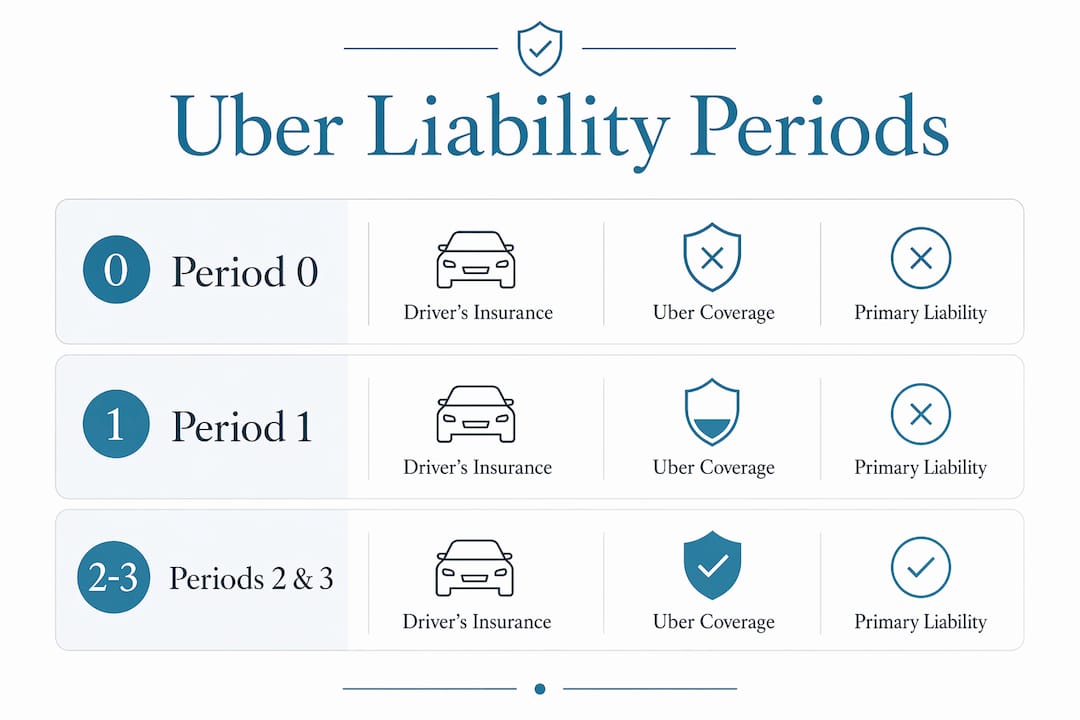
Period 0 covers the time when the Uber app is completely off. The driver is treated as a private motorist. Only their personal auto insurance applies. If a third-party driver causes an accident during this period, that third party's insurer is solely responsible, and Uber has no involvement.
Period 1 begins the moment the driver logs into the Uber app but has not yet accepted a ride request. This is where claims get complicated. Uber provides contingent liability coverage capped at $50,000 per person for bodily injury, $100,000 per accident, and $25,000 for property damage. The word "contingent" matters here. Uber's coverage only activates if the driver's personal insurer denies the claim. Most personal policies exclude rideshare activity, so personal policies deny rideshare claims when the app is on. That leaves victims with only the minimal Period 1 limits.
Periods 2 and 3 cover the time from ride acceptance through trip completion. Uber provides primary commercial liability up to $1,000,000 for bodily injury and property damage. This coverage applies regardless of how the driver is classified.
| Period | App Status | Uber Coverage | Primary Payer |
|---|---|---|---|
| Period 0 | App off | None | Driver's personal insurer |
| Period 1 | App on, no ride | $50k/$100k/$25k contingent | Third-party driver's insurer first |
| Period 2/3 | Ride accepted or active | $1,000,000 primary | Uber's commercial policy |
Pro Tip: Screenshot the Uber app immediately after any accident. The timestamp and trip status visible on screen are the fastest way to establish which coverage period applies before data gets overwritten.
When and how third-party drivers become liable in Uber accidents
A third-party driver becomes liable when their negligence causes or contributes to the accident. Fault is determined the same way as in any car crash: police reports, witness statements, traffic camera footage, and physical evidence. The difference in a rideshare collision is that multiple insurance policies may all be relevant at once.
When a third-party driver is at fault during an active Uber trip (Period 2 or 3), their personal auto insurance is the first line of recovery. Uber's $1,000,000 commercial policy acts as a secondary layer if the third party's coverage is insufficient. Liability in rideshare accidents involves layering between driver, rideshare company, and third parties, with fault and app status as the key determinants.
The situation changes sharply when the third-party driver is uninsured or underinsured. Uber carries uninsured and underinsured motorist (UM/UIM) coverage for passengers during active trips. In California, Senate Bill 371 caps UM/UIM coverage at $60,000 per person for accidents caused by uninsured third-party drivers. That cap took effect with 2026 legislative updates and represents a significant limit on recovery for passengers in states with similar laws.
Key considerations when a third-party driver is liable in your Uber accident:
- Collect the third-party driver's insurance information at the scene.
- Report the accident to Uber through the app immediately.
- File a claim with the third-party driver's insurer as the primary claim.
- If that insurer denies or underpays, escalate to Uber's UM/UIM coverage.
- Document all medical treatment, lost wages, and property damage from day one.
- Consult a rideshare accident attorney before accepting any settlement offer.
Pro Tip: If the third-party driver is uninsured, request Uber's UM/UIM coverage in writing within the first week. Delays in formal requests give insurers grounds to dispute coverage eligibility.
How Uber's independent contractor model affects liability claims
Uber classifies its drivers as independent contractors, not employees. That classification is deliberate. It limits Uber's direct vicarious liability for a driver's negligence. You generally cannot sue Uber simply because its driver caused an accident. Claims against Uber as a company require showing independent fault, such as negligent hiring, inadequate background checks, or failure to remove a driver with a known safety record.
California law adds another layer. Under California Civil Code §2100, rideshare drivers are common carriers, which means they owe passengers the highest duty of care. That standard strengthens legal claims against the driver personally and opens the door to company liability arguments when Uber's own conduct contributed to the harm.
California's Proposition 22 and Senate Bill 371 both shape the liability environment for rideshare claims in that state. Proposition 22 preserved the independent contractor classification for gig workers. Senate Bill 371 set the UM/UIM caps described above. Together, they define the boundaries of what victims can recover and from whom.
| Liable Party | Basis for Claim | Coverage Source |
|---|---|---|
| Third-party driver | Negligence causing the accident | Third party's personal auto insurance |
| Uber driver | Negligence during active trip | Uber's $1M commercial policy |
| Uber as company | Negligent hiring or screening | Uber's corporate liability coverage |
Rideshare accident claims increasingly proceed through arbitration rather than court trials, driven by Uber's driver contracts and independent contractor terms. Arbitration moves faster but limits discovery options, which is one reason early legal counsel matters so much.
Practical steps for pursuing a third-party liability claim after an Uber accident
The first 48 hours after an Uber accident determine the strength of your claim. Evidence disappears fast, and insurance companies move faster.
Follow these steps from the accident scene through claim resolution:
- Secure the scene. Call 911 and get a police report filed. The report establishes the official record of fault.
- Document everything. Photograph vehicle positions, damage, road conditions, traffic signs, and any visible injuries. Record the third-party driver's license plate, insurance card, and contact details.
- Preserve Uber app data. Screenshot your trip status, driver name, and timestamp immediately. App status evidence such as trip logs and GPS data is the most critical form of evidence for establishing which coverage period applies.
- Report to Uber. Use the in-app help feature to report the accident. Uber's safety team will create an incident record, which becomes part of your claim file.
- Seek medical care immediately. Even if you feel fine, get evaluated. Delayed injury documentation gives insurers a reason to dispute causation.
- File with the third-party driver's insurer. This is your primary claim. Provide the police report, photos, and medical records.
- Engage Uber's insurance if needed. If the third-party driver's coverage is insufficient or they are uninsured, formally request Uber's UM/UIM or excess liability coverage in writing.
- Track all damages. Keep records of medical bills, prescription costs, lost wages, and any out-of-pocket expenses related to the accident.
- Consult a rideshare attorney. Do this before accepting any settlement. Rideshare accident liability involves multi-layer insurance claims that require specialized legal knowledge to navigate correctly.
Pro Tip: Ask your attorney to send a litigation hold letter to Uber within the first two weeks. This formally demands preservation of GPS logs, trip records, and driver app data. Without it, that data may be deleted before you can use it.
For riders involved in crashes outside major metro areas, Accidentsurvivalguide covers rideshare accident liability in specific California locations, including guidance on which policy applies first when a non-rideshare driver is at fault.
Key Takeaways
Third-party driver liability in Uber accidents is determined by the at-fault driver's insurance first, then Uber's layered commercial coverage based on app status at the time of the crash.
| Point | Details |
|---|---|
| App status controls coverage | Uber's coverage ranges from zero to $1,000,000 depending on whether the driver had an active trip. |
| Third-party insurer pays first | The at-fault third-party driver's personal auto insurance is the primary recovery source. |
| Period 1 gap is real | Minimal $50k/$100k/$25k limits apply when the app is on but no ride is accepted. |
| UM/UIM caps limit recovery | California's Senate Bill 371 caps uninsured motorist coverage at $60,000 per person for 2026. |
| Evidence preservation is urgent | GPS logs and app data must be formally requested early or they may be permanently lost. |
What I've learned about third-party Uber claims that most people get wrong
Most people who contact Accidentsurvivalguide after an Uber accident assume Uber's $1,000,000 policy is always available. It is not. I have seen too many victims discover mid-claim that the driver's app was in Period 1 at the time of impact, which drops available coverage by more than 90%. That discovery comes too late to change their strategy.
The second mistake I see constantly is ignoring the third-party driver's own insurance. Victims focus on Uber's commercial policy because the numbers are larger. But if the third-party driver's insurer settles quickly and fairly, that is often the cleaner path. Chasing Uber's coverage when a simpler claim exists wastes time and legal fees.
The third issue is arbitration. Uber's contracts push many claims into arbitration, which limits your ability to conduct full discovery. If you do not act fast to preserve electronic evidence, you may walk into arbitration with no GPS data, no trip logs, and no proof of which coverage period applied. That is a winnable case turned into a losing one by delay.
My honest advice: treat the first 48 hours as the most important legal window of your entire claim. Get the police report, screenshot the app, and call an attorney who handles rideshare cases specifically. General personal injury attorneys often miss the coverage period nuances that determine whether you recover $25,000 or $1,000,000.
— Scott
How Accidentsurvivalguide can help you after an Uber accident
Figuring out who owes you money after a rideshare crash is genuinely hard. Accidentsurvivalguide was built to make that process less overwhelming.
Start with the free accident compensation calculator to get a realistic picture of what your claim may be worth before you talk to any insurer. The tool accounts for medical costs, lost wages, and pain and suffering in rideshare accident scenarios. Accidentsurvivalguide also publishes detailed legal guides on Uber and Lyft accidents across dozens of cities, including Ann Arbor rideshare accident guidance covering which policy applies first when another driver is at fault. Use these resources before you accept any offer or sign any release.
FAQ
Who is liable in an Uber accident involving a third-party driver?
The at-fault third-party driver's personal auto insurance is primarily liable. Uber's commercial coverage applies as a secondary layer if the third party's policy is insufficient or they are uninsured.
What is the Period 1 gap in Uber insurance coverage?
Period 1 is when the Uber app is on but no ride has been accepted. Coverage is limited to $50,000 per person, $100,000 per accident, and $25,000 for property damage, and only activates if the driver's personal insurer denies the claim.
Does Uber cover passengers when an uninsured driver causes the accident?
Uber provides UM/UIM coverage for passengers during active trips when an uninsured third-party driver is at fault. In California, Senate Bill 371 caps that coverage at $60,000 per person as of 2026.
Can you sue Uber directly for a third-party driver's negligence?
Uber's independent contractor classification generally prevents direct vicarious liability claims. Claims against Uber as a company require proving independent fault, such as negligent hiring or failure to screen drivers properly.
Why does app status matter so much in Uber accident claims?
App status determines which insurance period applies and therefore how much coverage is available. GPS logs and trip data are the primary evidence used to establish app status, and that data must be formally preserved early or it may be deleted.