
Product liability in truck accidents is the legal principle that holds manufacturers, parts suppliers, and distributors responsible when a defective truck component causes or worsens a crash. This is separate from driver negligence or trucking company fault. You can pursue both types of claims at the same time, which opens the door to more defendants, more insurance coverage, and potentially higher compensation. If your accident involved a brake failure, a blown tire, or a steering malfunction, a product liability claim may apply directly to your case.
Truck accident product liability explained: the three defect types
Product defects fall into three categories: manufacturing defects, design defects, and failure-to-warn defects. Each one demands different evidence and supports a different legal theory. Knowing which type applies to your crash shapes every decision your attorney makes.
Manufacturing defects
A manufacturing defect happens when a specific unit leaves the factory in worse condition than intended. The design was fine. The production process failed. An example is a brake caliper that was assembled with the wrong torque specification on a single truck, causing it to seize under load. The defect exists in that one part, not across the entire product line.
Design defects
A design defect affects every product built to that blueprint. If a truck manufacturer's standard fuel tank placement creates a fire risk in rear-end collisions, every truck built to that spec carries the same danger. These cases are often larger in scope because the entire product line is implicated, not just one unit.
Failure-to-warn defects
Failure-to-warn defects, sometimes called marketing defects, arise when a product lacks adequate safety instructions or warnings. A tire rated for highway speeds but sold without clear load-limit warnings for commercial use is a classic example. The product itself may work as designed, but the absence of proper guidance makes it unreasonably dangerous.
How defect type affects your claim matters practically. Strict liability rules mean you do not have to prove the manufacturer was careless. You only need to show the product was defective and that the defect caused your injury. This lowers the evidentiary bar compared to a standard negligence claim.
- Manufacturing defect: Preserve the actual part. Photos, serial numbers, and chain of custody documentation are critical.
- Design defect: Gather technical specifications, recall notices, and similar incident reports across the product line.
- Failure-to-warn: Collect all packaging, manuals, and warning labels present at the time of the crash.
Pro Tip: Request the truck's full maintenance and inspection history within days of the crash. Repair shops and fleet operators sometimes replace or discard defective parts quickly, destroying your evidence before you know it exists.
Who can be held liable in a truck product liability claim?
Multiple parties share liability in truck accident cases, and product liability adds an entirely separate layer of defendants beyond the driver and trucking company. Identifying every responsible party early is not just smart strategy. It directly affects how much compensation you can recover.
The table below contrasts the defendants in a standard negligence claim versus a product liability claim.
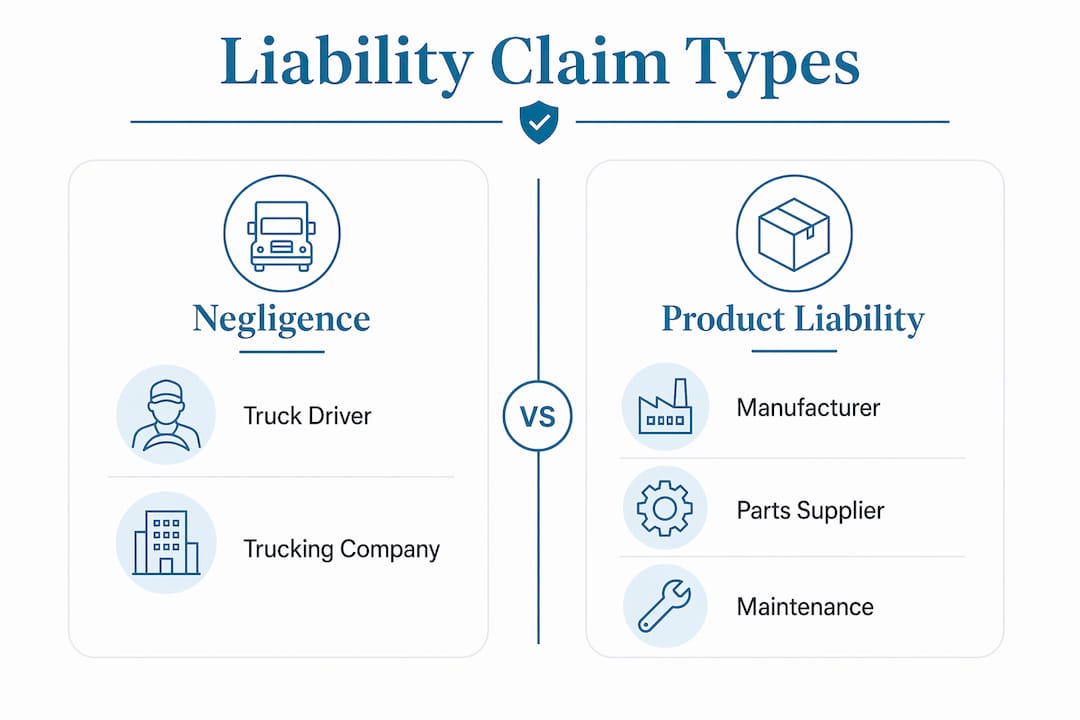
| Claim Type | Typical Defendants |
|---|---|
| Driver Negligence | Truck driver, trucking company (vicarious liability) |
| Product Liability | Truck manufacturer, parts supplier, third-party maintenance contractor |
| Combined Claim | All of the above simultaneously |
Truck manufacturers like Freightliner, Kenworth, or Volvo Trucks can be named if a vehicle system they designed or built contributed to the crash. Parts suppliers such as Bendix (brakes) or Michelin (tires) face liability when their specific components fail. Third-party maintenance contractors who service brakes, tires, or steering systems can be liable if improper service caused or worsened a defect.
Trucking companies carry their own exposure through vicarious liability for driver actions. But they can also face direct liability if they ignored known defects or skipped required inspections. The employer liability angle is worth exploring alongside any product defect claim.
Layering a product liability claim onto a negligence claim is not redundant. It targets different defendants, triggers different insurance policies, and creates more paths to full compensation. Attorneys call this a multi-theory complaint strategy, and it is standard practice in serious truck crash litigation.
How do federal preemption rules affect your claim?
Federal preemption is the legal argument that federal trucking regulations override state tort law, blocking your lawsuit. Defense attorneys raise it often. The good news is that it rarely succeeds in motor vehicle safety cases.
The 2026 Supreme Court decision in Montgomery v. Caribe Transport II confirmed that federal preemption does not bar state safety tort claims related to motor vehicles. That ruling preserves your right to sue under state product liability law even when federal safety standards exist. The Court's reasoning was that federal standards set a floor, not a ceiling, for safety obligations.
The ruling also has implications for truck broker liability. Brokers who negligently select carriers with known safety violations can now face state tort claims in many jurisdictions. The post-ruling legal landscape signals that courts are willing to let fact-intensive safety disputes go to juries rather than dismissing them on preemption grounds.
What this means for your claim: expect the defense to raise preemption arguments anyway. They do it to delay and discourage. Your attorney needs to frame your claim around the specific safety risk the defendant controlled, not just the general federal standard that applies to the industry.
Pro Tip: If a defense attorney argues federal preemption early in your case, ask your attorney to cite Montgomery v. Caribe Transport II directly. That ruling gives plaintiffs strong footing to push past preemption motions in motor vehicle product liability cases.
What steps should victims take to build a strong claim?
The window to preserve critical evidence in a truck product liability case closes fast. Trucking companies have legal teams and accident response protocols. You need to move with the same urgency.
- Secure the defective component immediately. Request through your attorney that the truck be placed under a legal hold. Chain of custody documentation for defective parts, including photos, telematics data, and maintenance records, is the foundation of your case.
- Obtain all maintenance and inspection records. Brake failures cause 29% of serious large truck crashes involving mechanical issues. Brake-system violations appear in over 40% of out-of-service inspections. Those records exist. Get them.
- Hire a qualified technical expert early. Expert testimony links defects to causation in language courts and insurers understand. An engineer who can explain why a specific brake design fails under load conditions is far more persuasive than a general claim of malfunction.
- Coordinate your negligence and product liability claims. Both claims require discovery, but they target different defendants and different evidence. Your attorney needs to run parallel tracks without letting one investigation compromise the other.
- Consult a truck accident attorney with product liability experience. General personal injury attorneys handle car crashes. Truck product liability cases involve federal regulations, commercial insurance stacking, and technical expert coordination. The specialization matters. Review the damages you may be entitled to recover before your first attorney consultation so you walk in informed.
Key takeaways
Product liability in truck accidents gives victims a direct legal path to manufacturer and supplier accountability, separate from and in addition to driver negligence claims.
| Point | Details |
|---|---|
| Three defect categories | Manufacturing, design, and failure-to-warn defects each require different evidence and legal theories. |
| Strict liability advantage | You prove the product was defective and caused harm, not that the manufacturer was careless. |
| Multiple defendants available | Manufacturers, parts suppliers, and maintenance contractors can all be named alongside the driver and trucking company. |
| Federal preemption is not a barrier | The 2026 Montgomery v. Caribe Transport II ruling preserves state product liability claims in motor vehicle cases. |
| Evidence preservation is urgent | Secure defective parts, maintenance records, and telematics data immediately after the crash. |
Why product liability claims are the most overlooked tool in truck crash cases
I have seen a lot of truck accident victims focus entirely on the driver and the trucking company. That instinct makes sense. The driver was behind the wheel. The company owned the truck. But stopping there often leaves real money on the table.
The part that surprises most people is how often a defective component is a contributing factor, not just a background detail. Brake violations show up in more than 40% of out-of-service inspections. That is not a fringe issue. That is a systemic problem, and it means manufacturers and suppliers are in the chain of causation far more often than victims realize.
The other thing I have learned is that the evidence window is brutal. Trucking companies move fast. Parts get replaced. Records get "lost." The victims who recover the most are the ones who treat evidence preservation like an emergency, not an afterthought. Get an attorney on the phone before you talk to any insurance adjuster. Ask specifically whether a product defect investigation is part of their plan.
The 2026 Montgomery ruling is genuinely good news for plaintiffs. Courts are signaling that they will not let federal preemption arguments shut down legitimate safety claims. That shifts leverage toward victims. Use it.
If you are dealing with a truck crash right now, do not assume your case is just a negligence claim. Ask the harder question: did something on that truck fail before it should have? The answer might change everything about your case.
— Scott
Start building your truck accident claim today
Truck accident product liability cases are complex, but you do not have to figure them out alone. Accidentsurvivalguide was built specifically for people in your situation, by people who have been through serious accidents themselves.

Use the free accident compensation calculator to get an estimate of what your claim may be worth before you speak with an attorney or accept any settlement offer. Then explore the full Accidentsurvivalguide resource library for step-by-step guidance on evidence preservation, insurance tactics, medical documentation, and connecting with experienced truck accident attorneys nationwide. Knowledge is your best protection right now.
FAQ
What is product liability in a truck accident?
Product liability in a truck accident is the legal responsibility of manufacturers, parts suppliers, or maintenance contractors when a defective component causes or contributes to a crash. It applies regardless of whether the driver was also negligent.
Can i file both a negligence and a product liability claim?
Yes. Product liability claims can be layered alongside negligence claims, targeting different defendants and insurance policies at the same time. This multi-theory approach often increases total compensation.
Does federal law block state product liability lawsuits?
Federal preemption does not categorically bar state product liability claims in motor vehicle cases. The 2026 Supreme Court ruling in Montgomery v. Caribe Transport II confirmed state tort claims remain valid even when federal safety standards apply.
What truck parts most commonly trigger product liability claims?
Brakes, tires, and steering systems are the most common components involved. Brake failures account for 29% of serious large truck crashes tied to mechanical issues, making them a primary focus in defect investigations.
How long do i have to file a truck product liability claim?
Statutes of limitations vary by state, typically ranging from 2–4 years from the date of the crash. Consult a truck accident attorney as soon as possible, since evidence preservation deadlines arrive long before the legal filing deadline does.